
Travertine and Pressure: Why Calibration Matters
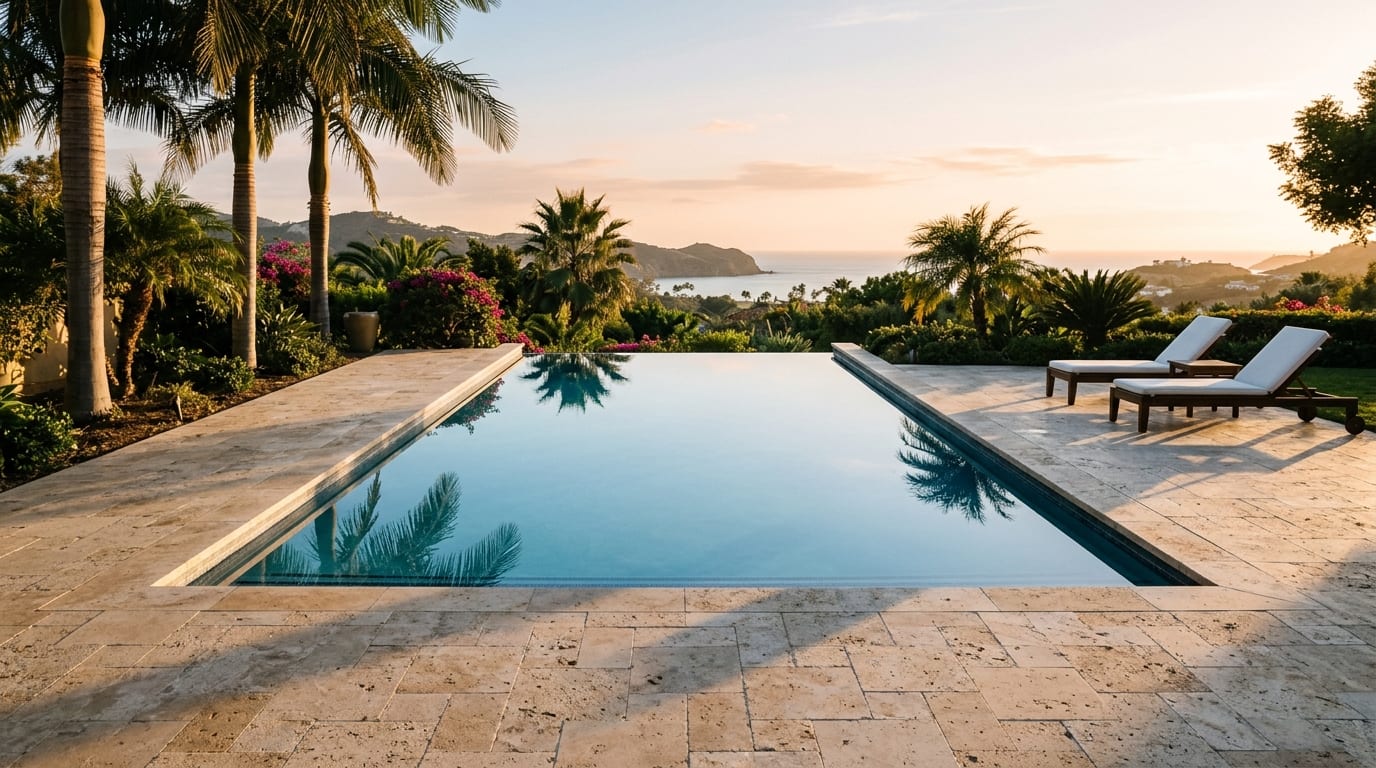
Travertine is the most common pool-deck and patio stone in desert and coastal luxury homes. It is also the surface most often damaged by pressure washing — and the damage does not reverse.
What goes wrong
Travertine is a porous, relatively soft stone. A pressure washer calibrated for concrete — or simply run at its default setting — does not just clean travertine. It erodes the honed face of the stone. The result is a section that reads as a lighter, rougher patch from then on, because the surface has literally been worn away. No subsequent cleaning, sealing, or polishing restores it. The only remedy is replacement of the affected stone.
This single error — correct equipment, wrong calibration — is the most common pressure-washing damage event in the regions Clean Freaks Co serves. It is also entirely avoidable.
Understanding travertine as a material
Travertine is a sedimentary limestone formed from mineral-rich groundwater, and its defining characteristic is its cellular porosity: the voids that run through the stone and give it its distinctive texture. Those voids are both a visual feature and a practical vulnerability. Filled travertine — where the voids have been grouted — is more uniform and somewhat more resistant to moisture absorption. Unfilled travertine, with its natural open voids, absorbs water and cleaning chemistry readily, which affects both cleaning method and chemistry choice.
The honed surface finish common on pool decks and patios is a ground-flat finish that reduces surface roughness while retaining the stone’s matte character. It is this honed face that pressure washing erodes. The softer the stone (travertine Mohs hardness is approximately 3, compared to granite at 6–7), the lower the pressure threshold at which erosion occurs. A crew that knows concrete responds to 2,500 PSI and assumes travertine will tolerate the same is working from a category error.
The principle: chemistry does the work, not force
Cleaning travertine correctly inverts the usual instinct. The pressure is calibrated below the threshold that erodes the stone, and a pre-treatment chemistry does the actual lifting — breaking down the biological staining, mineral deposit, and embedded debris so that low pressure is enough to rinse it away. The water is finishing the job, not forcing it.
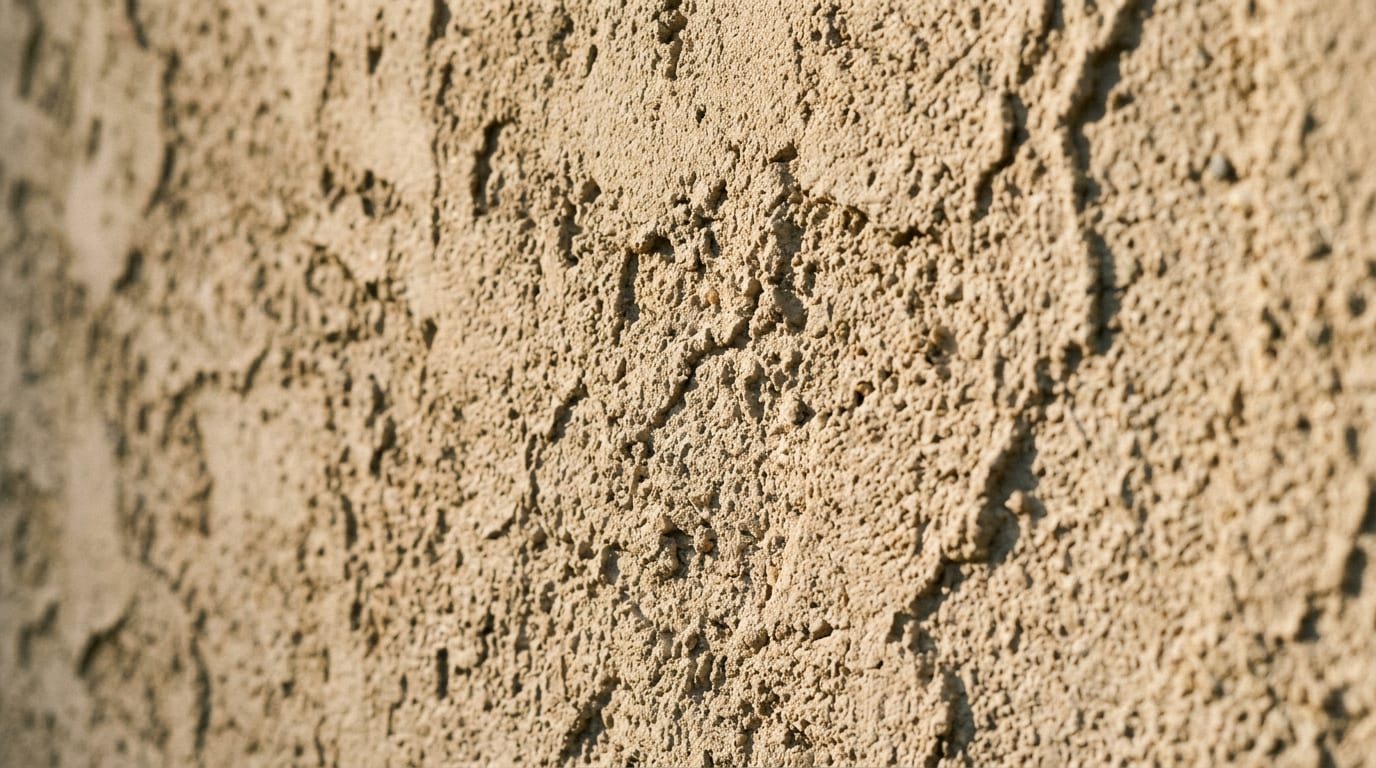
For stucco, the principle goes further still: stucco is generally a soft-wash surface, cleaned almost entirely by chemistry at low pressure, because pressure can drive water behind the finish. A partner who treats travertine and stucco like concrete is the wrong partner for a desert or coastal home.
The chemistry used on travertine must be pH-neutral or slightly alkaline. Acid-based cleaners — appropriate for concrete or some ceramic tile — etch travertine and dissolve the calcium carbonate in the stone. This is a less common error than pressure damage but an equally irreversible one. A crew bringing the wrong chemistry to a travertine job can damage the stone without the owner seeing anything amiss until the finish has deteriorated. pH-neutral or stone-specific alkaline cleaners are the correct choice; the label matters.
Grout and filled voids: the other part of the system
Travertine decks are a composite surface: the stone tiles and the grout or fill between them are two different materials that respond to cleaning and to pressure differently. Grout is softer than the stone and erodes from high-pressure washing faster. On a filled travertine deck, pressure that the stone face might tolerate can strip the fill from the voids and damage the grout lines between tiles. The result is a deck that looks worse after cleaning than before, with voided grout lines that collect debris and biological growth more aggressively than a sound fill would.
Inspection of grout condition before cleaning is part of a capable crew’s process. Grout that is already failing needs to be noted before the cleaning, not discovered during or after it. A cleaning that exposes failing grout did not cause the problem, but the client needs to know what the cleaning revealed and what re-grouting looks like as a next step.
Sealer is part of the conversation
Travertine is usually sealed, and the sealer wears unevenly over years. Cleaning can accelerate the last of a worn sealer. A capable partner assesses sealer condition during the inspection and tells you plainly whether resealing is worthwhile — quoted as a separate decision, not bundled in by default. A freshly cleaned, unsealed travertine deck will stain again quickly; that is worth knowing before the work, not after.
Sealer type also matters. Penetrating sealers — which absorb into the stone and protect from within — are generally preferred for travertine over topical sealers, which sit on the surface and can develop a sheen that changes the stone’s appearance and peels under UV exposure and foot traffic. An impregnating penetrating sealer, correctly applied to a clean, dry surface, typically lasts three to five years before it needs reapplication. The cleaning visit is the right moment to assess whether the existing sealer is still performing.
Regional conditions and what they add to the challenge
Desert travertine decks face a specific combination: intense UV degrades sealers faster, thermal cycling from high daytime to cooler nighttime temperatures creates expansion and contraction stress at grout lines, and monsoon season deposits biological material that roots aggressively in the porous stone. Pool decks add chlorine-splash exposure, which can affect both the stone and the sealer if the chemistry is not managed.
Coastal travertine decks face salt air and persistent moisture, which together promote biological growth faster than desert conditions — particularly on shaded portions of a deck. The biological load on a coastal travertine deck adjacent to a pool can be substantial by the end of a Florida or Southern California summer, and the cleaning chemistry needs to address it fully rather than simply rinse the surface.
What to ask before the work starts
Two questions separate a verified stone partner from a general pressure-washing crew. First: what pressure setting will you use on the travertine, and why. Second: are you soft-washing the stucco or pressure-washing it. A partner who answers both specifically — calibration below the erosion threshold, soft-wash for stucco — has done this before. A partner who answers “don’t worry, we do this all the time” has not answered the question.
A third question worth asking: what chemistry do you use on travertine? The answer should name a pH-neutral or stone-safe alkaline product. An answer that references muriatic acid or a general concrete cleaner is a signal to ask further before any work begins.
Surface calibration is one of the specific capabilities a pressure-washing partner is verified for before listing. See pressure-washing coverage or request a quote.
Why trust this
Guidance held to a published standard.
Clean Freaks Co connects homeowners with exterior cleaning across Arizona, California, and Florida — markets where travertine pool decks and patios are common and where pressure-washing damage to natural stone is a recurring, preventable event. Partners who handle stone surfaces are verified for calibration knowledge and correct chemistry selection before they are listed.
This Journal is written and reviewed to that same standard. Method guidance follows stone-industry trade sources and manufacturer specifications, and defaults to the conservative approach where surface damage cannot be reversed. Read how the Journal is written and reviewed.
Questions
Frequently asked.
How do I know if my travertine was damaged by pressure washing?
The primary indicator is a change in surface texture: an area that appears lighter, more matte, or rougher than the surrounding stone after cleaning. On a honed deck, eroded areas often appear as slightly white or chalky patches because the refined surface has been ground away, exposing more of the stone’s interior texture. The damage is usually visible from an angle in low light. If in doubt, run a hand across the surface — eroded stone feels perceptibly rougher than the surrounding intact hone. No resealing will restore the original face; affected tiles need replacement.
Can acid-based cleaners be used on travertine?
No. Travertine is a calcium carbonate stone, and acid dissolves calcium carbonate. Muriatic acid, vinegar, and most concrete cleaners that rely on acidic chemistry will etch travertine — dulling the finish and leaving a surface that is more porous and more susceptible to future staining. The correct chemistry for travertine is pH-neutral or stone-safe alkaline. If a crew proposes an acid treatment for biological staining or mineral deposits on a travertine surface, that is an indication they are working from a concrete framework rather than a stone one.
How often should a travertine pool deck be cleaned and resealed?
Annual cleaning is the appropriate cadence for most travertine pool decks in desert and coastal markets. Sealer reapplication typically runs every three to five years for a penetrating impregnating sealer, though high-UV environments and heavy pool use can accelerate wear at the lower end of that range. The cleaning visit is the right moment to assess sealer performance — a freshly cleaned surface makes it easy to see where the sealer is failing. Resealing should follow cleaning by enough time for the stone to fully dry, typically 24–48 hours depending on conditions.
What is the difference between filled and unfilled travertine for cleaning purposes?
Filled travertine has its natural voids grouted with a compatible material, creating a more uniform surface. Unfilled travertine retains its natural open voids. For cleaning, unfilled travertine requires more attention to chemistry concentration — solutions can penetrate deeply into the open voids and require thorough rinsing to clear. Filled travertine is somewhat more forgiving of surface treatment but requires attention to the grout condition, since the grout is softer than the stone and erodes from excessive pressure faster. Both types are correctly cleaned at low pressure with appropriate chemistry; neither tolerates high pressure.
Should travertine be cleaned differently near a pool versus on a remote patio?
Pool-adjacent travertine carries an additional variable: chlorine exposure from splash and splash-back. Chlorine at pool concentrations does not damage travertine directly, but it can degrade sealers over time and, combined with organic matter from the pool environment, contributes to a specific biological load. A post-season cleaning on a pool deck addresses this accumulation. Remote patio travertine without pool exposure faces primarily biological growth, mineral deposits from irrigation or sprinkler overspray, and standard outdoor soiling — a somewhat simpler cleaning profile, though the method and pressure requirements are identical.
Related reading
More from the Journal.

For your home
Exterior cleaning, calibrated to the surface.
Travertine, stucco, pavers, and pool decks each ask for a different method — and the wrong pressure does damage that does not reverse. We connect you with an approved local partner calibrated to your surfaces. See pressure washing coverage, or send the details and your local partner will be in touch.
Request a quote
About Clean Freaks Co
Clean Freaks Co is a premier luxury home cleaning service company that has carved a niche in the cleaning industry with its top-tier services. With a keen focus on luxury homes, we ensure every detail is handled with the utmost care and precision, providing a level of service that goes above and beyond the norm.
Our services are comprehensive and tailored to meet the unique needs of luxury homes. We offer residential cleaning, carpet & floor cleaning, window cleaning, and exterior cleaning. Our team of professionals is committed to providing the highest level of service, ensuring your home is pristine and inviting.
We believe in using natural cleaning products that not only deliver exceptional results but also protect our clients and the environment. Our commitment to eco-friendly cleaning solutions is part of our mission to provide a clean and safe environment for luxury homeowners.
Clean Freaks Co operates in three major states, specifically in Atherton & Los Altos Hills, California; Paradise Valley, Arizona; and Jupiter Island & Golden Beach, Florida. We are proud to serve luxury homeowners in these areas and are dedicated to exceeding our clients' expectations with every service we provide.
Choosing Clean Freaks Co means choosing a team that understands the unique needs of luxury homes. Our attention to detail, commitment to using natural cleaning products, and dedication to providing a superior customer experience set us apart. We take pride in transforming luxury homes into pristine living spaces where our clients can relax and enjoy their surroundings.
For more information or to schedule a service, please contact us at skyler.salterra@gmail.com. We look forward to providing you with a clean and safe environment that you'll love.
Written and published by Clean Freaks Co. How the Journal is written and reviewed →