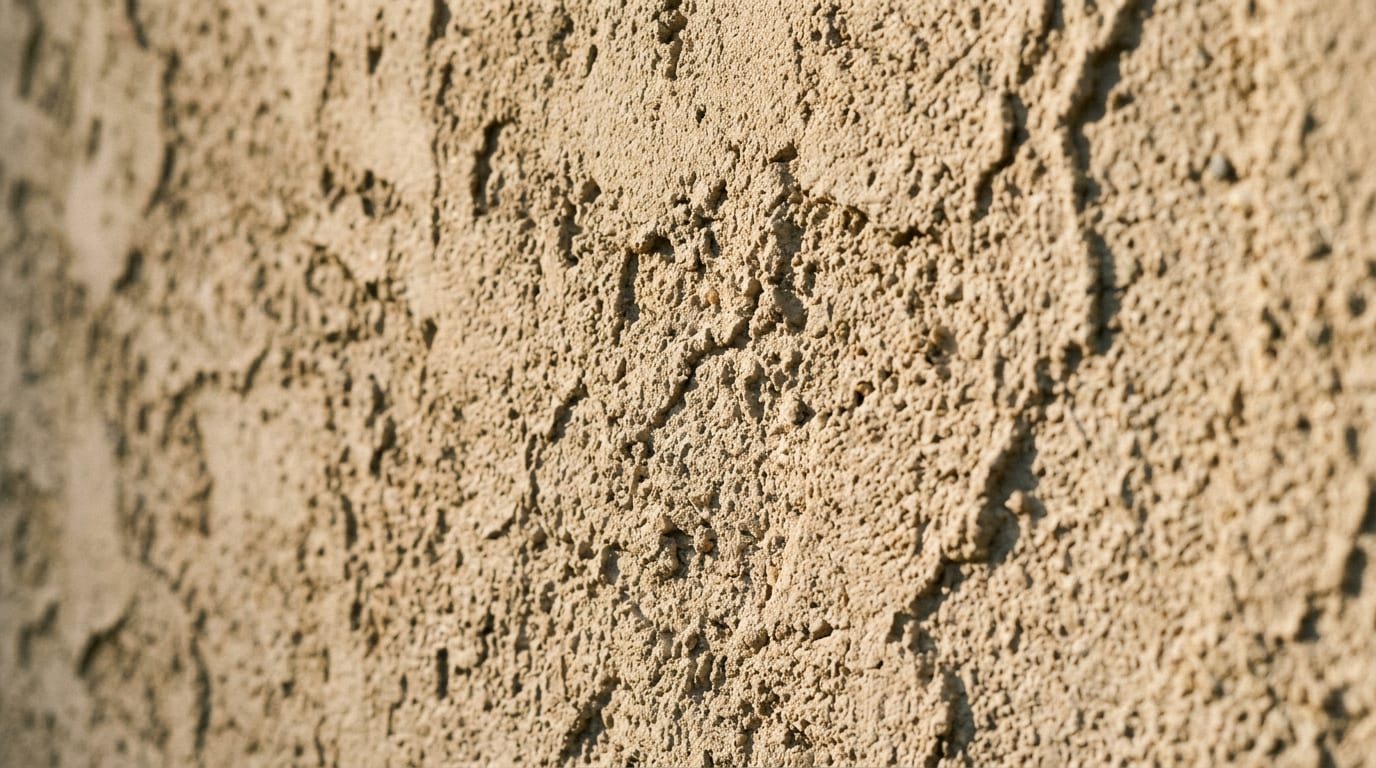
Stucco Cleaning: Why It Is Almost Never a Pressure Job
Stucco is one of the most common exterior finishes on luxury homes in the desert and on the coast. It is also one of the most commonly damaged — by the very thing many homeowners assume it needs.
What stucco actually is
Stucco is a cement-based plaster applied in layers over a substrate. Its surface is porous and, for all its solidity, more fragile than it looks. It is designed to shed water from the outside, not to have water driven into it under force. That single fact is why pressure washing and stucco are a bad pairing.
Traditional three-coat stucco — a scratch coat, a brown coat, and a finish coat — is approximately three-quarters of an inch thick over the lath. Synthetic stucco systems, often called EIFS (exterior insulation and finish system), are thinner and significantly more sensitive to water intrusion. Both types clean well with the correct method and both are damaged by the wrong one, though EIFS is considerably less forgiving of any pressure at all.
What pressure does to stucco
Aim a pressure washer at a stucco wall and several things go wrong. The force can chip and pit the surface, leaving a permanently rougher, uneven face. It drives water behind the finish, into the substrate, where trapped moisture invites cracking, staining that bleeds back through, and over time the failure of the stucco itself. On painted stucco it strips and lifts the paint. Damage that took seconds to cause becomes a repair-and-refinish project.
The moisture intrusion failure mode is the one that takes longest to become visible and is the most costly when it does. Water driven behind a stucco finish does not evaporate quickly. It sits in the substrate, wicks toward the framing, and in humid conditions promotes mold growth inside the wall cavity. Efflorescence — the chalky white mineral bleed-through that appears as salt deposits on the wall face — is a later symptom of the same moisture pathway. By the time it is visible, the stucco has been compromised for some time.
Soft washing is the correct method
Stucco is a textbook soft-wash surface. The correct process applies a cleaning chemistry at low pressure — enough to wet and treat the wall, never enough to drive water into it. The chemistry breaks down the dirt, biological staining, and fade-causing film; a gentle, controlled rinse removes it. The wall is cleaned by the solution, not by force. Done this way, stucco cleans up beautifully and safely — and because the chemistry kills algae and mildew at the root, it stays clean longer.
The chemistry used on stucco is typically a diluted sodium hypochlorite solution with a surfactant to improve adhesion and dwell time. The concentration is lower than what is used on concrete or tile, and the application pressure is calibrated to wet the surface without penetrating the finish. A capable crew applies the solution in sections and allows it to dwell before rinsing — the contact time is what does the biological work, not the volume or force of the application.
The biological-staining point
Most of what makes stucco look dirty — the dark streaking on north and shaded elevations, the green-grey cast — is biological growth, not loose dirt. Biological growth has roots in the porous surface. Pressure blasts off the visible top layer and leaves the roots, so it returns within weeks. Soft-wash chemistry kills it. This is why the right method is also the longer-lasting one.
Stucco’s porosity is what makes it particularly hospitable to biological growth. Algae, mildew, and lichen find purchase in the surface texture and, once established, hold moisture that accelerates further growth. North-facing and shaded elevations are consistently the most affected because they receive less UV and dry more slowly after rain or irrigation. A soft-wash treatment that kills the biology rather than simply removing the surface layer can extend the clean period from a few weeks to well over a year on these elevations.
Painted and sealed stucco: additional considerations
Stucco that has been painted or coated requires the same soft-wash approach with additional attention to chemistry concentration. Elastomeric paints — the flexible coatings commonly used over stucco in desert markets — tolerate soft-wash chemistry well at appropriate concentrations. At higher concentrations or with extended dwell times, fading is possible. A crew treating painted stucco should know the paint type and calibrate accordingly.
Sealed stucco presents a different consideration: the sealer condition matters for both the cleaning and for what happens after. A worn sealer on stucco allows biological growth to root more deeply in the surface, making cleaning harder and regrowth faster. Cleaning sometimes accelerates the last of a failing sealer. A capable partner assesses the sealer condition before the work and advises on whether resealing is worth considering after cleaning — as a separate decision, not a default upsell.
How to read a crew’s capability before work starts
Two questions surface the important information quickly. First: “Will you soft-wash or pressure-wash the stucco?” The answer should be soft wash, without qualification. Second: “What chemistry concentration do you use on painted versus unpainted stucco?” A crew that answers specifically — naming a different approach for each — understands the material. A crew that answers with a general assurance that they “do it all the time” without specifics has not answered the question.
The bottom line for stucco homes
If a crew proposes to pressure-wash your stucco, that is the moment to pause. The correct answer for stucco is almost always soft washing. A partner who leads with that — before you have to ask — is the partner who understands the material.
Soft-wash capability for stucco is verified before a pressure-washing partner is listed. See pressure-washing coverage or request a quote.
Why trust this
Guidance held to a published standard.
Clean Freaks Co connects homeowners with exterior cleaning across Arizona, California, and Florida — markets where stucco is the dominant exterior finish and where the consequences of the wrong cleaning method are both common and costly. Partners who handle stucco work are verified for soft-wash capability before they are listed; the question about method is not optional.
This Journal is written and reviewed to that same standard. Method guidance follows stucco manufacturer recommendations and trade sources, and defaults to the conservative approach where surface damage is irreversible. Read how the Journal is written and reviewed.
Questions
Frequently asked.
How do I know if my stucco was damaged by pressure washing?
Common indicators include surface pitting or roughness that was not present before, paint lifting or bubbling in the days following the cleaning, and efflorescence — chalky white deposits — appearing on the wall face in the weeks or months after. If a wall that was cleaned develops a blotchy, uneven appearance where it was previously uniform, moisture intrusion is a plausible cause. A stucco contractor can assess whether the finish has been compromised and what remediation looks like.
Is EIFS stucco cleaned the same way as traditional three-coat stucco?
Both are soft-wash surfaces, but EIFS requires particular care with chemistry and rinse pressure. EIFS is a thinner, foam-backed system with a synthetic finish coat that is more sensitive to moisture intrusion and chemical contact than traditional cement stucco. Chemistry concentration should be conservative, dwell time shorter, and rinse pressure minimal. A crew that treats EIFS identically to traditional three-coat stucco may still be within the soft-wash method but is not calibrating to the material. Confirming the stucco type with your crew before work begins is worthwhile.
How often should stucco be soft-washed?
Annual cleaning suits most homes. North-facing and heavily shaded elevations with established biological growth may warrant a shorter cycle — every eight to ten months — because they receive less UV and regrow more quickly. Desert homes benefit from a post-monsoon cleaning in fall, when the wet season’s biological load is at its peak for the year. Coastal homes with salt air benefit from at minimum annual cleaning, and more frequently where the biological load from salt-moisture is heavy on shaded surfaces.
Can soft washing remove stains that are not biological, such as rust or construction runoff?
Soft washing with standard sodium hypochlorite chemistry addresses biological staining effectively. Non-biological staining — rust from metal fixtures, tannin staining from landscaping, efflorescence from moisture intrusion, or construction runoff — requires different chemistry. Rust staining typically responds to an oxalic acid treatment applied separately from the biological clean. Efflorescence requires a mild acid treatment. A crew that offers only soft-wash chemistry for all stain types will improve biological staining and may not address other types. Knowing the stain type before scheduling helps ensure the right treatment is brought to the job.
Does soft washing harm the landscaping near a stucco wall?
When managed correctly, soft washing poses minimal risk to established plantings. The standard protocol is to pre-wet plants thoroughly before the chemistry is applied, rinse them during the job if overspray is occurring, and rinse again after the wall rinse. At the diluted concentrations that reach plantings through drift or runoff, harm to established plants is uncommon. Tender plants and edibles planted directly against the house are at higher risk and worth flagging to the crew before work begins so they can take additional precautions.
Related reading
More from the Journal.


For your home
Exterior cleaning, calibrated to the surface.
Travertine, stucco, pavers, and pool decks each ask for a different method — and the wrong pressure does damage that does not reverse. We connect you with an approved local partner calibrated to your surfaces. See pressure washing coverage, or send the details and your local partner will be in touch.
Request a quote
About Clean Freaks Co
Clean Freaks Co is a premier luxury home cleaning service company that has carved a niche in the cleaning industry with its top-tier services. With a keen focus on luxury homes, we ensure every detail is handled with the utmost care and precision, providing a level of service that goes above and beyond the norm.
Our services are comprehensive and tailored to meet the unique needs of luxury homes. We offer residential cleaning, carpet & floor cleaning, window cleaning, and exterior cleaning. Our team of professionals is committed to providing the highest level of service, ensuring your home is pristine and inviting.
We believe in using natural cleaning products that not only deliver exceptional results but also protect our clients and the environment. Our commitment to eco-friendly cleaning solutions is part of our mission to provide a clean and safe environment for luxury homeowners.
Clean Freaks Co operates in three major states, specifically in Atherton & Los Altos Hills, California; Paradise Valley, Arizona; and Jupiter Island & Golden Beach, Florida. We are proud to serve luxury homeowners in these areas and are dedicated to exceeding our clients' expectations with every service we provide.
Choosing Clean Freaks Co means choosing a team that understands the unique needs of luxury homes. Our attention to detail, commitment to using natural cleaning products, and dedication to providing a superior customer experience set us apart. We take pride in transforming luxury homes into pristine living spaces where our clients can relax and enjoy their surroundings.
For more information or to schedule a service, please contact us at skyler.salterra@gmail.com. We look forward to providing you with a clean and safe environment that you'll love.
Written and published by Clean Freaks Co. How the Journal is written and reviewed →