
Protecting Plantings During Exterior Cleaning
Exterior cleaning happens surrounded by landscaping — and the chemistry that lifts algae off a patio can scorch the plants beside it. Protecting the grounds is part of doing the job well.
Why the chemistry is a risk to plants
Most exterior soft-washing relies on cleaning solutions — frequently sodium hypochlorite based — that are effective on biological growth precisely because they are hard on living organisms. A plant is a living organism. Undiluted run-off, over-spray, or solution allowed to pool around roots can burn foliage, bleach leaves, and in a bad case kill an established planting. On a property where mature landscaping is itself a significant investment, this is not a small consideration.
The concentration used in professional soft washing typically runs between one and three percent sodium hypochlorite, diluted at point of application — far below the undiluted bleach a homeowner might recognize, but still concentrated enough to damage foliage on contact and to alter soil chemistry if it pools around a root zone. Sensitive plantings — desert succulents, ornamental grasses, fine-leaf tropical specimens — do not all respond the same way. Some species are more tolerant of incidental contact; others will show bleaching or tip-burn within 24 hours of even modest exposure.
How a careful crew protects the grounds
Plant protection is a protocol, carried out before and during the work, not an afterthought:
- Pre-wet the plantings. Foliage and soil saturated with clean water before cleaning begins absorb far less of any chemistry that reaches them — the plant is already “full.”
- Tarp and shield beds and specimens immediately adjacent to the work area.
- Plan the run-off. Know where the water will go before turning it on — away from beds, away from the lower garden on a graded lot, away from a storm drain or, on the coast, the ocean.
- Rinse during and after. Continuous and final rinsing dilutes anything that reaches a plant before it can do harm.
- Match chemistry to proximity. A gentler dilution near sensitive plantings, even if it means a second pass.
Pre-wetting is the most important step and also the most frequently skipped by crews who are moving quickly. A plant whose leaves and root zone are already saturated with clean water will absorb a fraction of the chemical contact that a dry plant will absorb under the same conditions. The pre-wet is not optional on any property with mature or high-value landscaping; it is a precondition for beginning the chemical work.
Grade makes it harder
On a hillside or sloped property, gravity carries run-off downhill into whatever is below — often the most established part of the garden. Cleaning a graded lot well means actively managing where the water goes, not just where it lands. A crew that has only worked flat lots may not plan for this.
On steep grades, run-off can travel further and faster than expected, pooling at the base of slopes in areas that were not part of the cleaning zone at all. Berms, temporary diversion channels, or the strategic placement of absorbent material at the downhill perimeter are among the methods a crew with graded-lot experience brings to the job. The question to ask before the crew starts is not just “will you protect the plantings near the work area” but “will you manage where the water ends up at the bottom of the lot.”
Specific materials near plantings
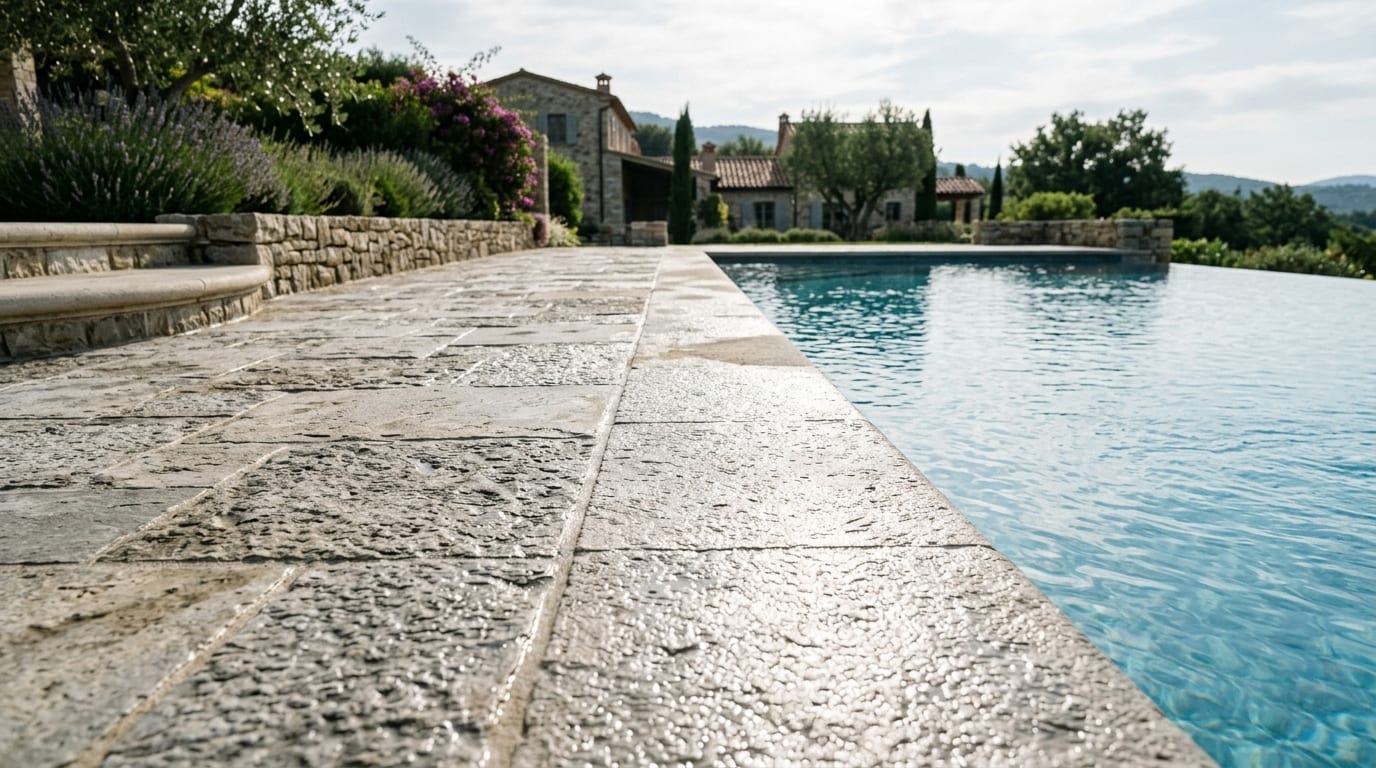
The surface being cleaned also informs how chemical run-off behaves. Travertine and other porous stone can hold cleaning solution in surface pores and release it slowly into adjacent soil during and after rinsing. Paver joints filled with polymeric sand present a similar situation: the cleaning solution can wick into the joint material and migrate laterally toward planting beds. A crew aware of this will apply chemistry conservatively near those edges and rinse more thoroughly at the perimeter.
Pool deck cleaning adjacent to planted areas requires particular care if the deck has any drainage that routes toward the garden. Some pool deck surfaces — brushed concrete, exposed aggregate — respond to higher pressure; others, like travertine or natural stone, require low-pressure soft washing. The method appropriate for the surface also affects how run-off is managed around it.
The regional dimension
Desert plantings and tropical plantings have different sensitivities, and a coastal property adds the ocean as something run-off must not reach. A capable partner accounts for the specific landscape they are working in — the question to ask before work begins is simply, “how will you protect the plantings?” A real answer comes back specific.
In Arizona and the California desert, drought-adapted plantings — agave, mesquite, palo verde — are broadly more tolerant of incidental contact than tropical specimens, but established saguaro or prized specimen cacti deserve the same pre-wet and shielding protocol. In coastal Florida and Southern California, tropical plantings with large leaf surfaces are more susceptible to chemical contact; the surface area of a broad leaf absorbs more than the narrow foliage of a desert plant. In coastal markets specifically, the proximity of storm drains and the potential for run-off to reach coastal waters adds a compliance dimension to the run-off management plan.
Planting protection is a standard part of how our pressure-washing partners work. See pressure-washing coverage or request a quote.
Why trust this
Guidance held to a published standard.
Clean Freaks Co connects homeowners with exterior cleaning across Arizona, California, and Florida through approved, insured local partners — crews who work regularly on properties with mature landscaping, graded lots, and sensitive plantings where run-off management is part of the job, not an afterthought. The protocols described in this piece reflect what those engagements actually require.
This Journal is written and reviewed to that same standard — material guidance follows industry trade sources and manufacturer dilution guidance, and defaults to the conservative method when chemistry or plant sensitivity creates uncertainty. Read how the Journal is written and reviewed.
Questions
Frequently asked.
What concentration of sodium hypochlorite is typically used in exterior soft washing?
Professional soft-wash applications typically run between one and three percent sodium hypochlorite at the point of application, diluted from a more concentrated stock solution. This is significantly below undiluted household bleach but still concentrated enough to damage foliage on direct contact or alter soil chemistry if it pools around a root zone. The correct pre-wet and rinse protocol reduces the actual exposure to plantings substantially below what that concentration implies in raw form.
Why is pre-wetting plantings so important before soft washing begins?
A plant whose foliage and root zone are already saturated with clean water will absorb a fraction of the chemical contact that a dry plant will absorb under the same conditions. The mechanism is simple: a saturated cell has less capacity to take up additional liquid. Pre-wetting is the highest-impact single step in planting protection and also the most commonly skipped on jobs where the crew is moving quickly. It is a non-negotiable precondition for any property with mature or valuable landscaping.
Does it matter that my property is on a slope when scheduling exterior cleaning?
It matters significantly. On graded lots, run-off carries downhill into whatever landscaping is at the lower elevation — often the most established part of the garden. A crew experienced only on flat lots may not plan for where water ends up at the base of the slope. The right question to ask before work begins is not just “will you protect the plants near the work area” but “how will you manage run-off at the bottom of the lot,” and the answer should come back specific.
Are desert plantings like agave and cactus less at risk from soft-wash chemistry than tropical plants?
Generally, drought-adapted desert species are somewhat more tolerant of incidental chemical contact than broad-leaf tropical specimens, whose larger leaf surface area absorbs more on contact. However, established specimen cacti — particularly prized saguaro — and ornamental succulents warrant the same pre-wet and shielding protocol used for any high-value planting. Tolerant is not the same as immune, and the cost of damaging a mature specimen plant exceeds the cost of the extra precaution by a wide margin.
What should I ask a crew before they start exterior cleaning near my landscaping?
Two questions with specific expected answers: “What is your pre-wet protocol for protecting plantings before you apply chemistry?” and “How will you manage run-off on my property, including where it ends up at the perimeter and lower elevation?” A crew with a real protocol answers both specifically. A crew without one will generalize or reassure. The specificity of the answer is itself the signal.
Related reading
More from the Journal.


For your home
Exterior cleaning, calibrated to the surface.
Travertine, stucco, pavers, and pool decks each ask for a different method — and the wrong pressure does damage that does not reverse. We connect you with an approved local partner calibrated to your surfaces. See pressure washing coverage, or send the details and your local partner will be in touch.
Request a quote
About Clean Freaks Co
Clean Freaks Co is a premier luxury home cleaning service company that has carved a niche in the cleaning industry with its top-tier services. With a keen focus on luxury homes, we ensure every detail is handled with the utmost care and precision, providing a level of service that goes above and beyond the norm.
Our services are comprehensive and tailored to meet the unique needs of luxury homes. We offer residential cleaning, carpet & floor cleaning, window cleaning, and exterior cleaning. Our team of professionals is committed to providing the highest level of service, ensuring your home is pristine and inviting.
We believe in using natural cleaning products that not only deliver exceptional results but also protect our clients and the environment. Our commitment to eco-friendly cleaning solutions is part of our mission to provide a clean and safe environment for luxury homeowners.
Clean Freaks Co operates in three major states, specifically in Atherton & Los Altos Hills, California; Paradise Valley, Arizona; and Jupiter Island & Golden Beach, Florida. We are proud to serve luxury homeowners in these areas and are dedicated to exceeding our clients' expectations with every service we provide.
Choosing Clean Freaks Co means choosing a team that understands the unique needs of luxury homes. Our attention to detail, commitment to using natural cleaning products, and dedication to providing a superior customer experience set us apart. We take pride in transforming luxury homes into pristine living spaces where our clients can relax and enjoy their surroundings.
For more information or to schedule a service, please contact us at skyler.salterra@gmail.com. We look forward to providing you with a clean and safe environment that you'll love.
Written and published by Clean Freaks Co. How the Journal is written and reviewed →