Pool Deck Restoration: When Routine Cleaning Is No Longer Enough
A pool deck that has gone several seasons without attention reaches a point where a routine wash no longer brings it back. That point is where cleaning ends and restoration begins.
Cleaning versus restoration
Routine pool-deck cleaning maintains a deck that is fundamentally in good condition — it lifts the recent season’s mineral, biological staining, and debris and resets the surface. Restoration is the deeper, sequenced process a deck needs once neglect has compounded: deep-set staining, failed sealer, accumulated mineral scale, and embedded debris that a single wash cannot resolve. The two are different scopes, and a partner should tell you honestly which one your deck needs rather than quoting a routine clean for a deck that is past it.
The distinction matters practically because misclassifying the scope produces a poor result and sets a false expectation. A routine clean applied to a deck that needs restoration will lift some surface debris and leave the owner with a deck that looks marginally better for a week before the deep staining reasserts. The owner concludes cleaning does not work, when the more accurate conclusion is that the wrong scope was applied.
What compounds on a neglected deck
- Mineral scale from years of pool splash-out, built into a hard layer near the water’s edge.
- Deep biological staining — algae and organic growth that has had seasons to root into porous stone.
- Failed or absent sealer — once the sealer is gone, the deck absorbs and holds staining far faster, accelerating the decline.
- Embedded debris — palm shed, organic matter, and grit worked deep into pores and joints.
Each of these compounds the others — an unsealed deck stains faster, the staining sets deeper, and the deck slides from “needs a clean” to “needs restoration.”
The compounding is particularly pronounced in Florida and coastal California. In Florida, heat and humidity give biological growth a year-round growing season; a deck that misses two years of cleaning can develop algae rooting deep enough into travertine or shell stone that it has to be treated with a penetrating biological treatment rather than a surface wash. In Arizona, the compounding mechanism is mineral: hard-water scale near the waterline builds into a deposit with the hardness of calcium carbonate cement. At that stage, it requires an acid-side dwell treatment — not pressure alone — to soften and remove it without damaging the stone underneath.
How restoration is approached
Restoration is sequenced and surface-aware. A full assessment first — the deck material, the staining types present, the joint and sealer condition. Then targeted pre-treatment, with mineral scale and biological staining addressed by separate chemistries rather than one product for everything. Then surface-calibrated cleaning — and on travertine or soft stone, this is where calibration still matters, because restoration must not become erosion. Finally, joint-sand reseating where needed, and a sealer assessment: a restored deck is the right moment to reseal, and a restored unsealed deck will simply begin the decline again.
The assessment phase is not a formality. The restoration plan depends on correctly identifying what is on the surface: heavy mineral scale requires an acid-side chemistry that would not be appropriate for a predominantly biological-stain problem, and vice versa. A surface with both requires a sequenced approach — one chemistry applied, fully dwelled, fully rinsed, then the second — because mixing the two neutralizes both. A crew that skips the assessment and applies a general-purpose product is guessing at the chemistry, and the result is predictably partial.
Travertine-specific restoration considerations
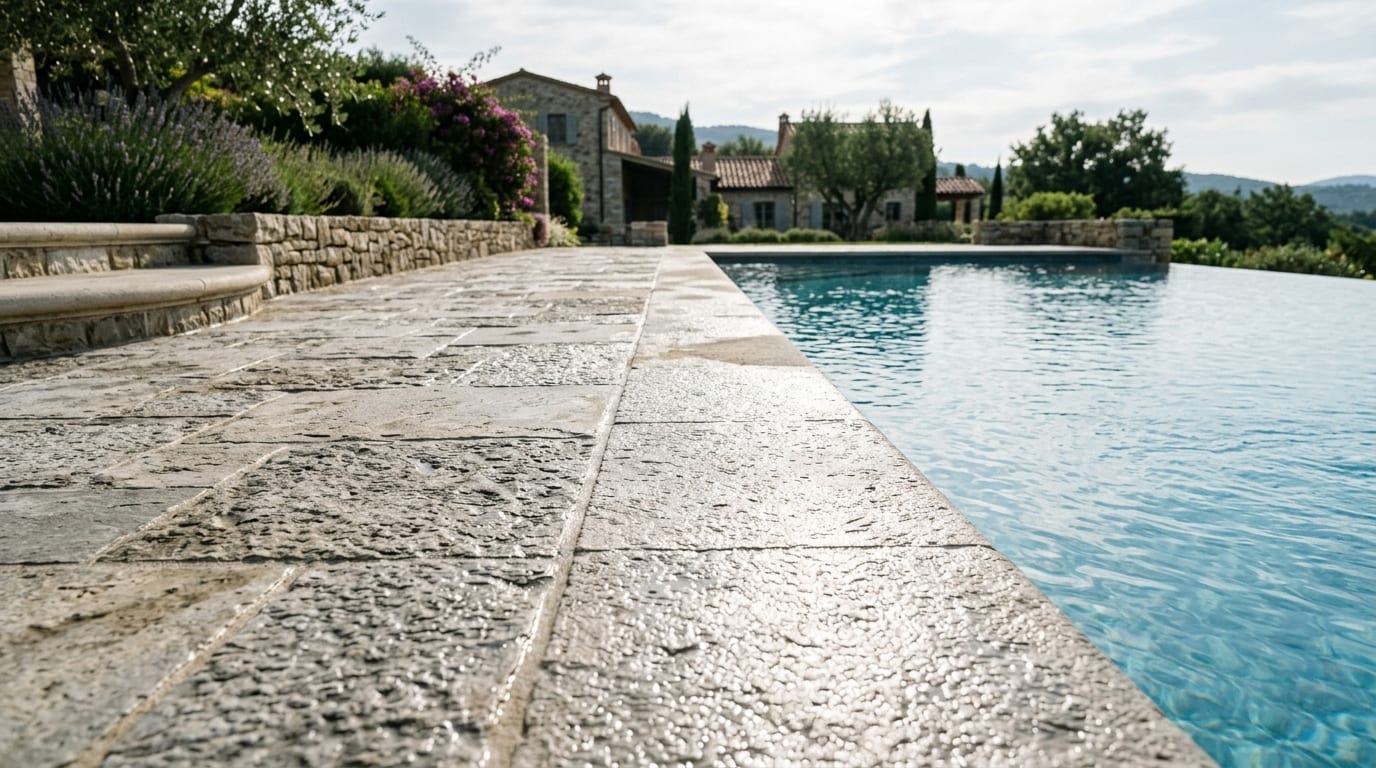
Travertine is the most common luxury pool-deck material in Arizona and Florida and the surface most often damaged during restoration attempts. The stone is soft calcite, and its natural surface voids — the characteristic pitting visible in the material — are part of its structure. High-pressure cleaning erodes the matrix surrounding those voids, which widens them and roughens the surface. A rougher surface holds biological growth and mineral scale more aggressively, accelerating the same cycle that caused the neglect to compound in the first place.
Correctly restoring travertine means relying on chemistry to do the work of removing the staining, with pressure calibrated low enough to clear the lifted residue without eroding the substrate. In severe cases of biological staining, a penetrating biological treatment applied and allowed to dwell overnight before wet work begins is the conservative approach. It is slower, but it removes the staining without requiring the mechanical force that damages the stone face.
The joint question
Paver pool decks have a joint-sand component that routine cleaning and restoration affect differently. Routine cleaning, done carefully, does not significantly disturb well-settled polymeric sand. A restoration scope — which involves more aggressive surface work and sometimes joint probing to assess depth of embedded organic matter — may disturb joint sand to a degree that requires reseating. Joint sand loss is not cosmetic; it allows paver movement, weed establishment, and water infiltration under the field, which can undermine the base over time. A restoration that includes joint inspection and reseating where disturbed is a more complete scope than one that addresses only the surface.
When to call it restoration
The signals are straightforward: the deck has gone multiple seasons untouched; routine cleaning no longer resolves the staining; the surface absorbs water immediately, showing the sealer is gone; or a major event is coming and the deck will be the setting. Restoration ahead of resealing is also the correct order — sealer needs a fully restored substrate to bond to.
The pre-event trigger deserves its own note. A deck restored and resealed two to four weeks before a large outdoor event gives the sealer time to cure fully, gives the owner a chance to identify any areas that need a follow-up pass, and ensures the deck photographs well. A rushed restoration the day before an event leaves no margin for cure time or correction.
Pool deck restoration is a defined scope, distinct from routine cleaning, that our partners are verified for. See pressure-washing coverage or request a quote.
Why trust this
Guidance held to a published standard.
Clean Freaks Co connects homeowners with pool deck restoration — assessed, sequenced, and material-calibrated — across Arizona, California, and Florida through approved, insured local partners who are verified for restoration scope, not only routine cleaning. The distinction between those two scopes is part of the vetting standard.
This Journal is written and reviewed to that same standard. Guidance on restoration sequencing, travertine handling, and mineral-scale treatment follows manufacturer and trade sources and defaults to the conservative method. Read how the Journal is written and reviewed.
Questions
Frequently asked.
How do I know if my pool deck needs restoration rather than routine cleaning?
The primary signals are: visible staining that has persisted through previous cleaning attempts; the surface absorbs water immediately when droplets hit it (indicating the sealer is gone); mineral scale near the waterline that feels hard and raised to the touch; or biological staining — dark or greenish discoloration — that extends beyond surface deposits into the stone pores. If a routine clean has been done in the last twelve to eighteen months and the deck still looks like this, restoration is the correct scope.
Will restoration damage my travertine pool deck?
Restoration done correctly will not damage travertine. The risk is restoration done incorrectly — specifically, using high pressure to do what chemistry should be doing. Travertine restoration should rely on appropriately chosen cleaning chemistry, adequate dwell time, and low-pressure delivery to clear lifted residue. A crew that understands the material operates this way. A crew that does not will use pressure as a substitute for chemistry and leave the surface roughened and more susceptible to future staining.
Should the deck be resealed after restoration, and how long does that take?
Yes, for most stone pool decks. A freshly restored surface is the correct substrate for sealer application — the pores are open and clean, and the sealer bonds well. Applying sealer to a stained or debris-laden surface traps the contamination and compromises adhesion. Penetrating sealers for travertine and natural stone typically require twenty-four to forty-eight hours of dry conditions to cure before the surface is returned to use, and full cure before heavy pool-deck traffic is usually forty-eight to seventy-two hours.
How is mineral scale removed from travertine without damaging the stone?
Mineral scale is calcium carbonate — the same material as the travertine itself — so the challenge is dissolving the deposited scale without etching the stone substrate. The professional approach uses a dilute phosphoric or citric-acid-based treatment applied and dwelled rather than pressure-driven removal. The chemistry softens the mineral deposit so it can be lifted with low-pressure rinse. Concentration and dwell time are calibrated to the deposit thickness; a heavier scale requires a longer dwell, not a stronger acid, to avoid etching the surface.
How far in advance of an event should pool deck restoration be scheduled?
A minimum of two to three weeks before the event date, and four weeks is more comfortable. That window allows time for the restoration work itself, any follow-up pass on areas that need additional attention, and full sealer cure before the deck carries event traffic. Attempting restoration the week before a major event leaves no margin for cure time, weather delays, or correction passes. The restoration may be technically complete but the sealer may not be at full hardness, and the owner has no opportunity to evaluate and address anything before guests arrive.
Related reading
More from the Journal.


For your home
Exterior cleaning, calibrated to the surface.
Travertine, stucco, pavers, and pool decks each ask for a different method — and the wrong pressure does damage that does not reverse. We connect you with an approved local partner calibrated to your surfaces. See pressure washing coverage, or send the details and your local partner will be in touch.
Request a quote
About Clean Freaks Co
Clean Freaks Co is a premier luxury home cleaning service company that has carved a niche in the cleaning industry with its top-tier services. With a keen focus on luxury homes, we ensure every detail is handled with the utmost care and precision, providing a level of service that goes above and beyond the norm.
Our services are comprehensive and tailored to meet the unique needs of luxury homes. We offer residential cleaning, carpet & floor cleaning, window cleaning, and exterior cleaning. Our team of professionals is committed to providing the highest level of service, ensuring your home is pristine and inviting.
We believe in using natural cleaning products that not only deliver exceptional results but also protect our clients and the environment. Our commitment to eco-friendly cleaning solutions is part of our mission to provide a clean and safe environment for luxury homeowners.
Clean Freaks Co operates in three major states, specifically in Atherton & Los Altos Hills, California; Paradise Valley, Arizona; and Jupiter Island & Golden Beach, Florida. We are proud to serve luxury homeowners in these areas and are dedicated to exceeding our clients' expectations with every service we provide.
Choosing Clean Freaks Co means choosing a team that understands the unique needs of luxury homes. Our attention to detail, commitment to using natural cleaning products, and dedication to providing a superior customer experience set us apart. We take pride in transforming luxury homes into pristine living spaces where our clients can relax and enjoy their surroundings.
For more information or to schedule a service, please contact us at skyler.salterra@gmail.com. We look forward to providing you with a clean and safe environment that you'll love.
Written and published by Clean Freaks Co. How the Journal is written and reviewed →