
How Often Should Exterior Surfaces Be Cleaned?
There is no single right interval for exterior cleaning. Driveways, pool decks, patios, and facades each soil at their own rate — and climate moves all of them.
Different surfaces, different clocks
The mistake is thinking of “exterior cleaning” as one task on one schedule. A pool deck under palm canopy soils far faster than a driveway in full sun. A north-facing stucco wall grows biological staining while the south face stays comparatively clean. The right approach is a set of intervals, surface by surface, not a single date on the calendar.
The consequence of treating all exterior surfaces as a uniform job on one annual date is predictable: some surfaces are cleaned when they did not need it, and others — the ones accumulating biological staining in shade, or mineral deposit from pool splash, or oil in a frequently used parking area — are left overdue. The former is a minor inefficiency. The latter can be a surface damage problem.
A working framework
- Pool decks — twice yearly for most, plus a pre-season opening clean. Heavy palm-shed environments often move to quarterly.
- Patios and walkways — twice yearly is typical; shaded and damp areas that grow biological staining benefit from more.
- Driveways — twice yearly, often paired with patio visits; oil stains addressed promptly as they occur.
- Whole-home exterior soft-wash — annually for most homes; coastal and heavily shaded properties sometimes twice.
- Roof — on a longer cycle, every few years, driven by biological staining and tree cover.
Surface materials and pressure calibration
Pressure washing is not a uniform method applied uniformly. The correct pressure, nozzle angle, and chemical pre-treatment varies with the surface material, and the margin for error on sensitive materials is small.
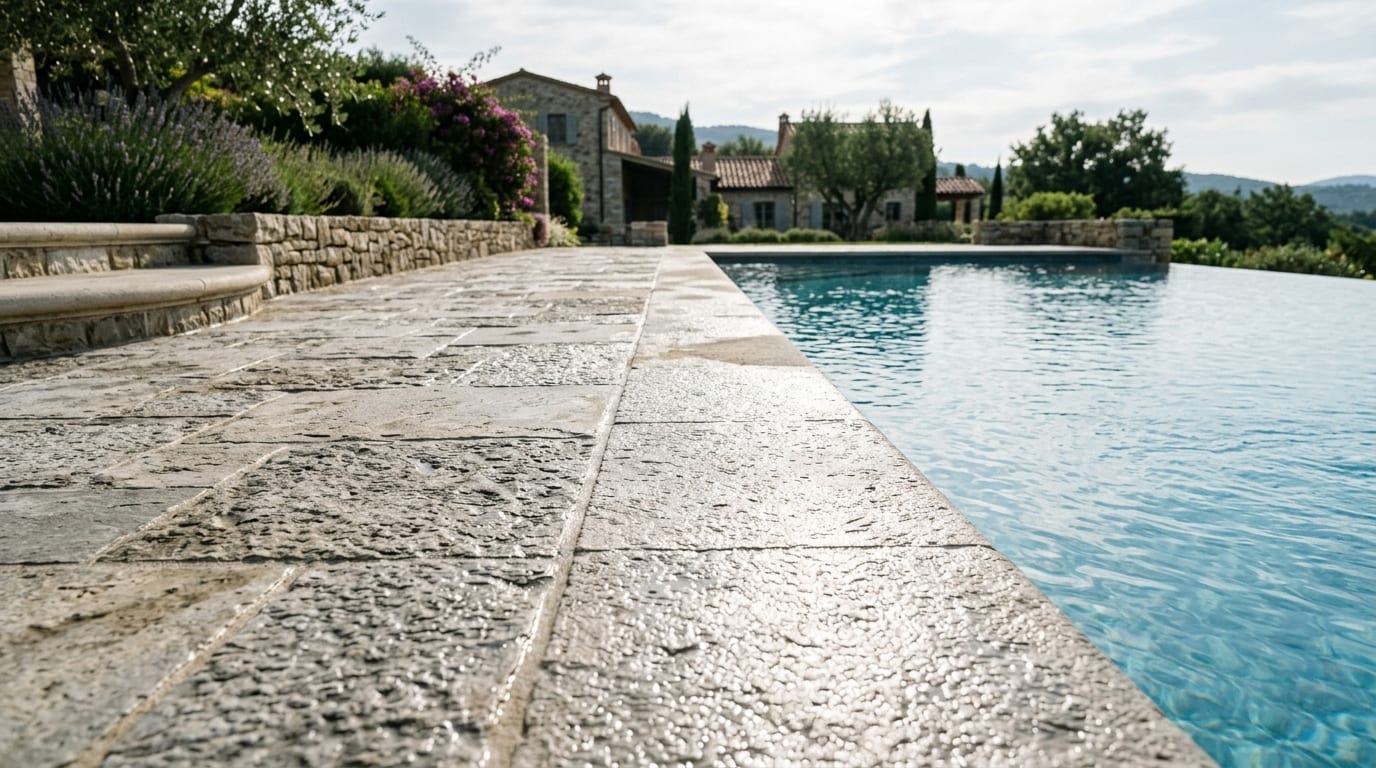
Travertine, limestone, and marble pavers are among the most pressure-sensitive surfaces on a residential exterior. These are soft, porous stones that can be etched by cleaning chemistry that is too acidic, and surface-abraded by water pressure that is appropriate for concrete but excessive for stone. A travertine pool deck should be cleaned at considerably lower pressure than a concrete driveway, and with a neutral or mildly alkaline surfactant rather than the acidic brighteners sometimes used on concrete. An operator who applies concrete-driveway technique to travertine will damage the stone.
Stucco and painted stucco present different considerations. Standard stucco can tolerate modest pressure when the surface is intact, but cracked, aged, or poorly adhered stucco can be driven open by pressure that would be unremarkable on concrete. Painted stucco compounds the risk: pressure or chemistry that penetrates a failing paint film creates moisture intrusion that causes peeling and eventually structural damage. Soft-washing — low pressure with chemical dwell time — is the correct method for stucco in most residential applications.
Concrete and pavers generally tolerate higher pressure, but sealed surfaces require lower pressure than unsealed ones to protect the sealant film. Sealed pavers that are power-washed at full pressure lose their sealant and must be resealed sooner than planned. The operator should know or ask whether exterior hardscape surfaces are sealed before selecting pressure settings.
Composite and timber decking each have their own requirements. Composite decking cleans effectively at moderate pressure but is sensitive to heat; hot-water pressure washing can soften composite boards and leave marks. Timber decking must be assessed for condition — a weathered, gray-surfaced board with surface checking can be damaged by high pressure that drives water into the checks. These surfaces often clean best with a wood-appropriate low-pressure method and a surfactant formulated for wood, followed by brightening if the surface is severely weathered.
Climate is the multiplier
The framework above shifts with where the home is. Humid coastal environments grow biological staining year-round and push every interval shorter. Desert homes deal less with biological growth but more with mineral deposit and blown grit. Heavy tree or palm canopy accelerates everything beneath it. Two identical patios in two climates do not share a schedule.
In Florida — particularly South Florida, the Gulf Coast, and Central Florida near water — biological staining on exterior surfaces is nearly continuous. Algae, lichen, and mold grow year-round in warm, humid conditions, and a surface that was clean in January may show significant biological growth by April. Pool decks under canopy can develop a slick algae film within eight to ten weeks during the wet season. The risk here is not cosmetic; it is a slip hazard. For wet-season Florida pool decks, a quarterly clean is often the minimum that maintains safe footing.
In Arizona and the inland California desert, the dominant exterior soiling is mineral deposit from hard water and wind-borne dust and grit. Biological staining is less prevalent in full-sun exposures but appears in shaded areas — north-facing walls, beneath covered patios, in planting areas with irrigation. The desert grit load is mechanical rather than chemical: fine particulate that abrades surfaces and discolors them, but does not bond the way biological staining does. This makes it easier to remove if addressed regularly, and more damaging in aggregate if left to accumulate over seasons.
The cost logic of not waiting too long
As with glass, there is a financial argument for the regular interval. Biological staining caught early lifts with routine cleaning. Left for years, it sets deep, sometimes etches or permanently discolors the surface, and turns a maintenance wash into a restoration job. Mineral deposit behaves the same way. The surface left too long does not just look worse — it costs more to bring back, and sometimes cannot be brought back fully.
Pool deck surfaces are particularly susceptible to this calculus. Travertine or natural stone that has grown heavy biological staining over multiple seasons may require a professional restoration treatment — chemical stain removal, mechanical grinding in severe cases, and re-sealing — that far exceeds the cumulative cost of the maintenance cleanings that would have prevented it. The homeowner who stretches the pool deck interval from twice yearly to once in three years often pays more in total than the one who maintained it correctly throughout.
Let the partner map it
The practical version is a partner walking the property once and proposing intervals surface by surface — this pool deck quarterly, that driveway twice yearly, the stucco annually. A schedule built from the actual home beats any number from a guide.
A pressure-washing partner can map a surface-by-surface cadence for your property. See pressure-washing coverage or request a quote.
Why trust this
Guidance held to a published standard.
Clean Freaks Co connects homeowners with exterior and pressure-washing services across Arizona, California, and Florida through approved, insured local partners who are verified for the specific surface materials present — travertine, stucco, pavers, and pool decks each require a different method, and a partner who cannot demonstrate the correct calibration for sensitive surfaces does not receive referrals for those properties.
This Journal is written and reviewed to that same standard — material guidance follows stone-care trade sources, manufacturer recommendations for surface materials, and defaults to the conservative pressure and chemistry choice when the consequence of error is surface damage. Read how the Journal is written and reviewed.
Questions
Frequently asked.
What is the difference between pressure washing and soft washing, and which does my home need?
Pressure washing uses high-velocity water to remove soiling mechanically — effective for concrete, hard pavers, and surfaces that can tolerate the force. Soft washing uses low pressure paired with a chemical pre-treatment (typically a dilute sodium hypochlorite or surfactant solution) that does the work chemically, with the water serving as a rinse rather than the primary cleaning agent. Soft washing is generally the correct method for stucco, painted surfaces, roof material, and older or sensitive stone, where high pressure can cause damage. Most residential exterior jobs use both methods in combination depending on surface type.
Can pool deck cleaning damage the stone or pavers if done incorrectly?
Yes — and travertine and natural stone pool decks are among the surfaces where cleaning error is most consequential. High pressure on soft stone causes surface erosion and can open the pores in ways that accelerate future staining. Acidic chemistry on calcium-based stone (travertine, limestone) causes etching that removes the surface finish and cannot be reversed without grinding and repolishing. Sealed stone cleaned at excessive pressure loses its sealant prematurely. A qualified operator will identify the stone type, confirm whether it is sealed, and select pressure and chemistry accordingly — not apply a default concrete setting to the pool deck.
How do I know if my exterior stucco is safe to pressure wash, or if it needs the soft-wash approach?
Stucco condition is the determining factor. Intact, undamaged stucco on a well-maintained home can tolerate modest pressure (typically under 1,500 PSI at the surface) for routine cleaning. Stucco showing cracks, delamination, or visible water damage should not be pressure washed at any meaningful pressure, as the force will drive moisture into the wall cavity and potentially worsen existing damage. Painted stucco with a failing or peeling paint film is similarly contraindicated for pressure. When in doubt, soft wash is the conservative and correct default for stucco in any condition.
Should driveways be sealed after cleaning, and how does that affect the cleaning frequency going forward?
Sealing a concrete or paver driveway after cleaning protects the surface from staining, slows the uptake of oil and organic material, and can reduce the frequency of professional cleaning needed to maintain the surface. A well-sealed driveway is meaningfully easier to clean than an unsealed one because soiling sits on the surface rather than penetrating it. The seal does wear over time — typically two to four years depending on traffic and climate — and should be reapplied before it fails completely. Cleaning before re-sealing, rather than sealing over existing staining, produces the best long-term result.
Is it safe to pressure wash a roof, or should I always use the soft-wash approach?
Pressure washing is contraindicated for most residential roof materials. Asphalt shingles are particularly vulnerable: high pressure strips the mineral granules from the shingle surface, which are there to protect the underlying asphalt from UV degradation. Removing them shortens the roof’s remaining service life. Clay and concrete tile can tolerate low pressure but are prone to cracking if an operator walks on them improperly or applies force at the wrong angle. Soft washing — low pressure with a biocide treatment to kill and remove biological staining — is the industry-recommended method for residential roofs and is both gentler and more effective at removing algae and lichen than pressure alone.
Related reading
More from the Journal.


For your home
Exterior cleaning, calibrated to the surface.
Travertine, stucco, pavers, and pool decks each ask for a different method — and the wrong pressure does damage that does not reverse. We connect you with an approved local partner calibrated to your surfaces. See pressure washing coverage, or send the details and your local partner will be in touch.
Request a quote
About Clean Freaks Co
Clean Freaks Co is a premier luxury home cleaning service company that has carved a niche in the cleaning industry with its top-tier services. With a keen focus on luxury homes, we ensure every detail is handled with the utmost care and precision, providing a level of service that goes above and beyond the norm.
Our services are comprehensive and tailored to meet the unique needs of luxury homes. We offer residential cleaning, carpet & floor cleaning, window cleaning, and exterior cleaning. Our team of professionals is committed to providing the highest level of service, ensuring your home is pristine and inviting.
We believe in using natural cleaning products that not only deliver exceptional results but also protect our clients and the environment. Our commitment to eco-friendly cleaning solutions is part of our mission to provide a clean and safe environment for luxury homeowners.
Clean Freaks Co operates in three major states, specifically in Atherton & Los Altos Hills, California; Paradise Valley, Arizona; and Jupiter Island & Golden Beach, Florida. We are proud to serve luxury homeowners in these areas and are dedicated to exceeding our clients' expectations with every service we provide.
Choosing Clean Freaks Co means choosing a team that understands the unique needs of luxury homes. Our attention to detail, commitment to using natural cleaning products, and dedication to providing a superior customer experience set us apart. We take pride in transforming luxury homes into pristine living spaces where our clients can relax and enjoy their surroundings.
For more information or to schedule a service, please contact us at skyler.salterra@gmail.com. We look forward to providing you with a clean and safe environment that you'll love.
Written and published by Clean Freaks Co. How the Journal is written and reviewed →