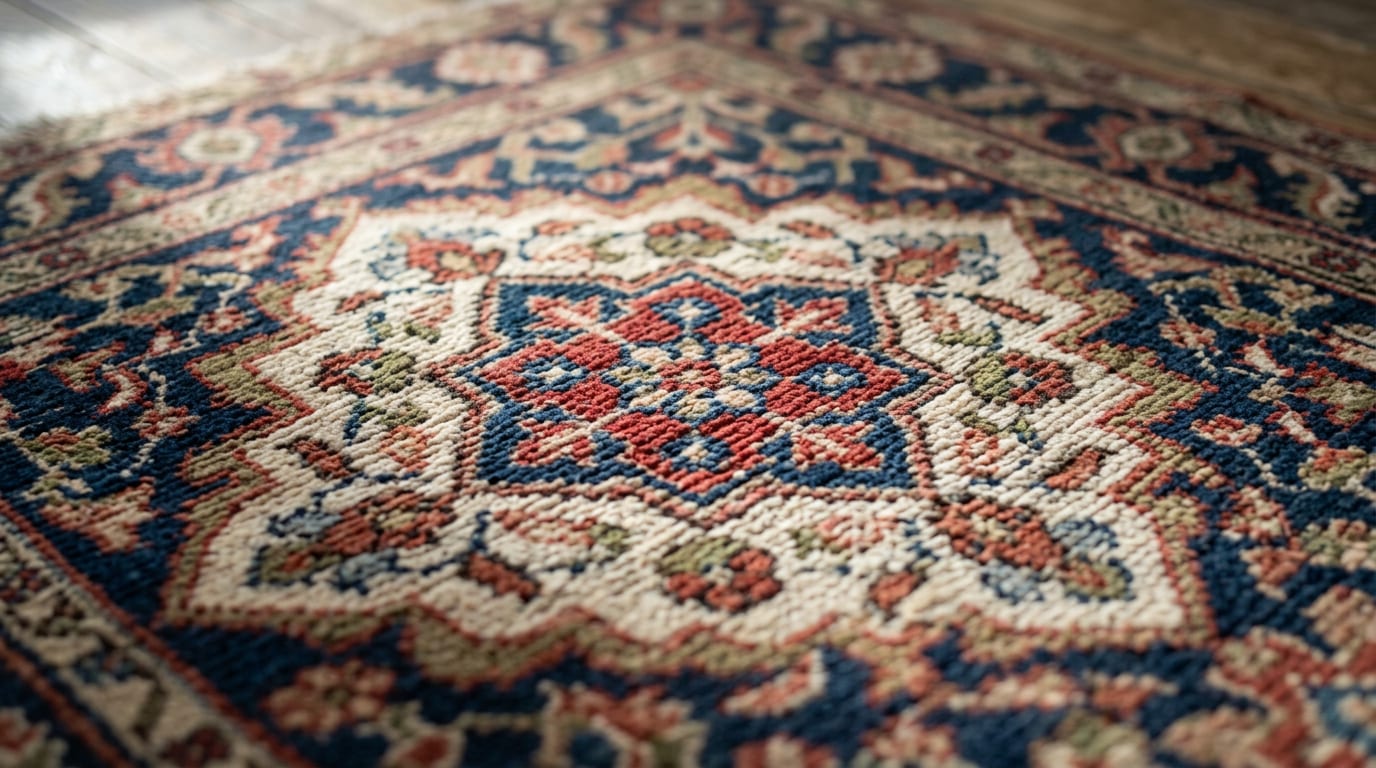
Wool and Silk-Blend Rugs: A Maintenance Primer
A wool or silk-blend rug is a textile, a piece of construction, and often an investment — and it does not respond to the chemistry, water, or handling that a synthetic carpet shrugs off. A short primer on keeping one well.
Why fiber changes everything
Wool absorbs moisture deeply and reacts to alkaline cleaners that synthetic fiber tolerates without complaint. Silk and silk blends are more delicate still, and prone to watermarking and sheen change if handled wrong. The single most consequential fact about fine-rug care is that the cleaning process must be selected for the fiber — water temperature, pH, dwell time, drying — and a process calibrated for synthetic wall-to-wall can fade dye, distort the weave, or, on an antique, accelerate damage that does not reverse.
Wool fiber is a protein fiber, chemically similar to hair, and it responds poorly to the highly alkaline detergents common in commercial carpet cleaning chemistry. A pH above about 8.5 begins to break down the cuticle structure of the wool fiber, which is what gives wool its resilience and sheen. The result is a rug that looks washed-out and feels coarser after the clean — damage that compounds with each subsequent exposure. Silk is even more sensitive, with a recommended pH range close to neutral (5 to 7) and a near-zero tolerance for heat.
Construction as a variable
Fiber type is the primary variable, but construction matters too. A hand-knotted rug — whether Persian, Turkish, or Central Asian in origin — has a foundation of cotton or wool warps and wefts that respond to moisture differently from the pile fibers. Over-wetting the foundation can cause it to contract unevenly as it dries, pulling the rug out of square in a way that is difficult to correct and impossible to fully reverse on an antique. A hand-tufted rug, which uses a canvas backing adhered with latex, presents a different problem: latex adhesives are degraded by hot water and aggressive steam, which causes the backing to separate from the pile — a failure mode that looks like the rug is shedding from the bottom up.
Machine-made wool rugs are generally more tolerant than hand-knotted pieces, but they are not immune to alkaline damage or over-wetting. The practical approach is to treat any rug whose exact construction is unknown conservatively, as though it were the more delicate type.
Routine care between professional cleanings
Three habits protect a fine rug more than anything done occasionally:
- Rotate it. Sun and traffic both wear unevenly. A rug rotated twice a year ages evenly instead of developing a faded half and a worn path.
- Vacuum with care. Gentle suction, no aggressive beater bar on the pile, and never on the fringe — fringe damage is among the most common and most avoidable.
- Address spills immediately and conservatively. Blot, never rub; lift moisture rather than drive it deeper; and resist the urge to apply a household stain product, several of which are alkaline enough to set a problem permanently into wool.
Spill response on wool and silk
The correct response to a fresh spill on a wool or silk rug is constrained, and the constraint is important. Blotting with a clean, colorfast cloth — working from the outside of the spill toward the center to avoid spreading — lifts the majority of liquid if done within the first few minutes. Cold water, applied sparingly and blotted out, can assist. What to avoid is almost as important as what to do:
- Do not rub. Rubbing distorts the pile direction in wool and breaks down the protein structure of silk fiber.
- Do not use white wine on red wine, or soda water, or club soda — these are household remedies with no advantage over clean cold water and the potential to add their own residue.
- Do not apply heat. Heat sets tannin-based stains (red wine, coffee, tea) into protein fiber and can cause dye migration in wool.
- Do not apply any commercial stain treatment without confirming it is rated for protein fibers at the specific dye type. When in doubt, call a specialist before applying anything.
When a rug should leave the home to be cleaned
Many fine and antique rugs are better cleaned off-site, in a controlled environment, than cleaned in place. A full immersion wash, proper rinsing, and controlled drying are difficult to do well on a living-room floor. A capable partner will tell you honestly when in-place cleaning is appropriate and when a rug should be collected, cleaned off-site, and returned — and will coordinate that rather than force a compromise.
Off-site cleaning allows the rug to be laid flat, fully immersed in a bath calibrated to its fiber and construction, rinsed thoroughly with appropriate water, and dried under controlled conditions that prevent the foundation from contracting unevenly. The fringe can be treated separately. The pile direction can be combed and set as the rug dries. None of this is available in a living room.
The boundary of maintenance
There is a line between cleaning and restoration. Re-piling, re-weaving, dye restoration, and conservation of a rare or historically significant rug are specialist work, and a maintenance partner should refer that work out rather than attempt it. Knowing the boundary — cleaning this rug well, declining to restore that one — is itself a mark of a partner worth keeping.
Wool and silk-blend capability is verified before a carpet partner is listed for a region. See carpet-cleaning coverage or request a quote.
Why trust this
Guidance held to a published standard.
Clean Freaks Co connects homeowners with fine-rug care — including wool, silk-blend, hand-knotted, and antique pieces — across Arizona, California, and Florida through approved, insured local partners held to a published standard. Fiber-specific capability is verified before a partner is listed, and the scope they are asked to assess includes construction type, not just surface condition.
This Journal is written and reviewed to that same standard — material guidance follows fiber-manufacturer care guidelines and textile conservation sources and defaults to the conservative method. Read how the Journal is written and reviewed.
Questions
Frequently asked.
How do I know if my rug is wool, silk, or a blend, and does it matter for cleaning?
It matters considerably. A burn test on a loose fringe fiber is the simplest field method: wool smells like burning hair and produces a crushable ash; silk behaves similarly but with a finer ash; synthetic fiber melts rather than burns and produces a hard bead. For a rug of value, the origin documentation or an appraisal will usually specify fiber content. When in doubt, treating the rug as the more sensitive fiber type and commissioning a specialist clean is the conservative approach.
Can I have a wool or silk rug cleaned in place, or does it always need to go off-site?
In-place cleaning is appropriate for some wool rugs — particularly newer, machine-made pieces on sound backing where low-moisture encapsulation cleaning can be applied carefully. Antique hand-knotted rugs and anything with a silk component almost always benefit from off-site immersion cleaning, where water temperature, pH, and drying conditions can be controlled. A specialist partner will assess the construction and tell you which is appropriate rather than defaulting to in-place for convenience.
My wool rug looks flat and dull after a professional clean — what went wrong?
Flattening and dullness after cleaning on a wool rug most commonly point to one of two causes: alkaline cleaning chemistry that has disrupted the cuticle structure of the wool fiber, or over-wetting followed by uneven drying that has compressed the pile. The first is a chemistry selection error and, if repeated, causes cumulative damage. The second is a process error that may resolve partly with a thorough grooming once the rug has dried completely. If the dullness persists, a specialist assessment is warranted before the rug is cleaned again.
How often should a fine wool or silk-blend rug be professionally cleaned?
Every twelve to eighteen months is a reasonable cadence for a rug in regular use in a high-traffic area. A rug in a low-traffic room or under furniture may extend to two to three years between professional cleans without meaningful consequence. The interval shortens significantly for homes with pets or young children. Between professional cleanings, the vacuum-and-rotate routine does most of the protective work.
Is rug padding important for a wool or silk rug, and what type is appropriate?
Padding is important for two reasons: it prevents the rug from sliding, which causes fringe abrasion and, on hard floors, edge fraying; and it reduces compression fatigue on the pile by providing cushioning between the rug and the hard floor surface. For wool and silk rugs, the appropriate padding is a felt-and-rubber combination — dense enough to cushion, non-slip at the base, and breathable enough to allow moisture to pass through rather than trap it. Avoid synthetic foam padding, which off-gasses over time and can bond to the rug backing in warm climates.
Related reading
More from the Journal.


For your home
Carpet care, matched to your home.
When the carpet in your home needs more than routine attention, we connect you with an approved local partner who knows the fiber, the traffic, and the standard your home keeps. See carpet cleaning coverage, or send the details and your local partner will be in touch.
Request a quote
About Clean Freaks Co
Clean Freaks Co is a premier luxury home cleaning service company that has carved a niche in the cleaning industry with its top-tier services. With a keen focus on luxury homes, we ensure every detail is handled with the utmost care and precision, providing a level of service that goes above and beyond the norm.
Our services are comprehensive and tailored to meet the unique needs of luxury homes. We offer residential cleaning, carpet & floor cleaning, window cleaning, and exterior cleaning. Our team of professionals is committed to providing the highest level of service, ensuring your home is pristine and inviting.
We believe in using natural cleaning products that not only deliver exceptional results but also protect our clients and the environment. Our commitment to eco-friendly cleaning solutions is part of our mission to provide a clean and safe environment for luxury homeowners.
Clean Freaks Co operates in three major states, specifically in Atherton & Los Altos Hills, California; Paradise Valley, Arizona; and Jupiter Island & Golden Beach, Florida. We are proud to serve luxury homeowners in these areas and are dedicated to exceeding our clients' expectations with every service we provide.
Choosing Clean Freaks Co means choosing a team that understands the unique needs of luxury homes. Our attention to detail, commitment to using natural cleaning products, and dedication to providing a superior customer experience set us apart. We take pride in transforming luxury homes into pristine living spaces where our clients can relax and enjoy their surroundings.
For more information or to schedule a service, please contact us at skyler.salterra@gmail.com. We look forward to providing you with a clean and safe environment that you'll love.
Written and published by Clean Freaks Co. How the Journal is written and reviewed →