
Why Stair Carpet Wears Faster Than the Rest of the House
In most homes the staircase carpet looks tired long before the rooms it connects. That is not a coincidence, and it is not a defect — it is geometry.
The whole household, on a small footprint
Every person in the home, every day, travels the staircase. A hallway distributes that traffic across its length; a staircase concentrates it onto a series of small tread surfaces. The carpet on a single stair tread absorbs more footfalls per square inch than almost any other textile in the house. Wear that takes a decade in a formal room takes a few years on a stair.
The tread width of a standard residential staircase is typically nine to ten inches of usable carpet surface. That narrow strip does all the work. In a home with children, pets, or frequent entertaining, the math is unambiguous: the staircase is the hardest-working carpet in the building.
The mechanics of stair wear
Two forces act on stair carpet. The first is compression — the pile is crushed flat at the front edge of each tread, the “nosing,” where the foot lands and pivots. The second is abrasion — soil tracked from outside acts as fine sandpaper, and the pivoting motion of a step grinds it into the fiber. Compression dulls the look; abrasion does the structural damage, cutting fiber at the base of the pile where it cannot be reversed.
The nosing itself deserves particular attention. Because the foot strikes and pivots at the same point on every descent, the front inch of each tread develops a distinct wear pattern: a compressed band, often with a visible color shift as the pile direction becomes permanently disrupted. On cut-pile carpets this reads as a lighter stripe. On looped-pile constructions the loops at the nosing may begin to snag or break entirely, starting a run that, unchecked, travels up the face of the riser.
Fiber type and stair performance
Not all stair carpet wears at the same rate. The fiber matters considerably:
- Nylon is the most abrasion-resistant synthetic and holds up well on stairs. A dense, high-twist nylon pile recovers from compression better than looser constructions and is a reasonable choice where longevity is the priority.
- Wool is resilient and wears well for its weight, but it is more susceptible to soil abrasion than a tightly twisted synthetic — it requires a shorter cleaning cadence to stay ahead of grit damage.
- Polypropylene (olefin) is inherently solution-dyed and very stain resistant, but it has low abrasion resistance and recovers poorly from compression. It is a poor choice for high-traffic stairs, whatever its other merits.
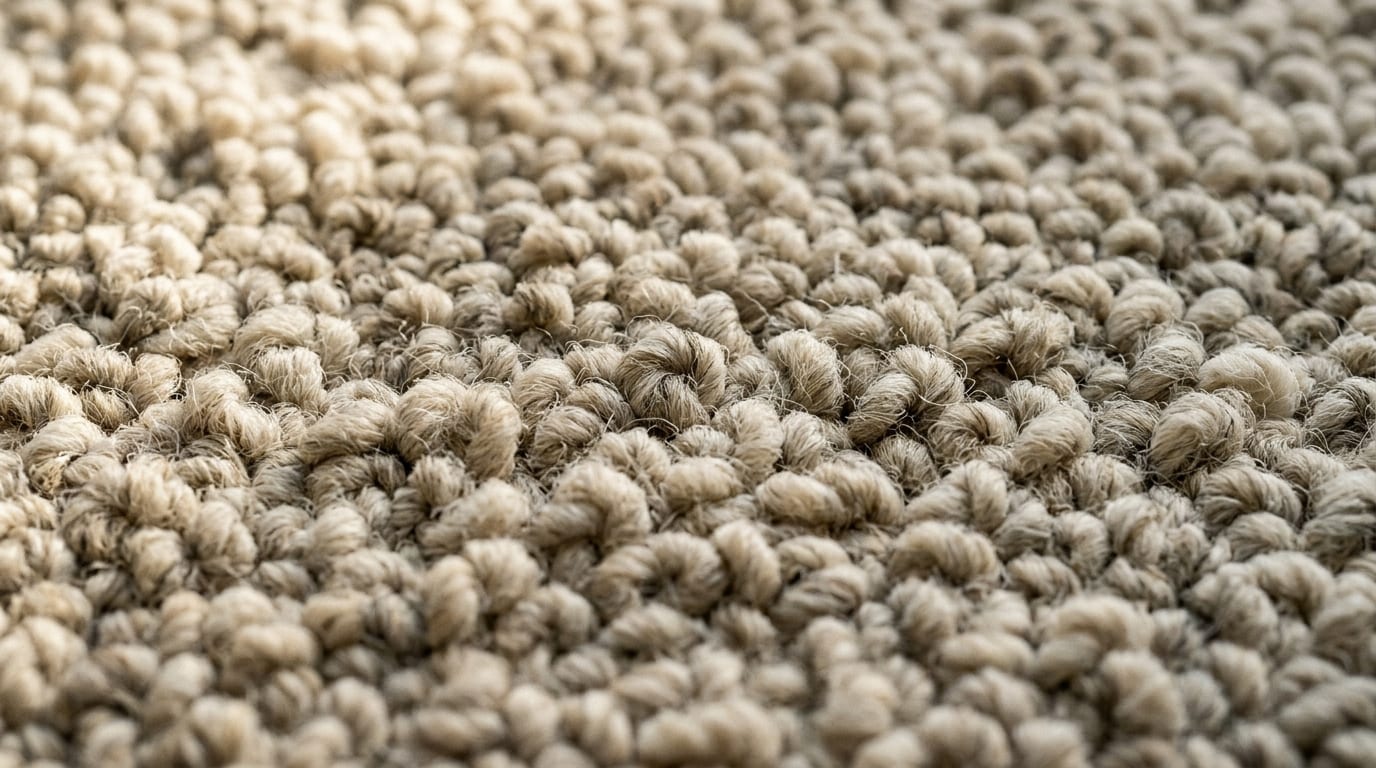
- Loop constructions (Berber) on stairs are a known risk: a single loop pulled at the nosing can cascade. If a looped carpet is already on the stairs, the nosing is the first thing to monitor at every clean.
Why stairs resist ordinary cleaning
Stairs are also genuinely harder to clean well. The tread-and-riser geometry, the tight turns of a winding staircase, and the way a runner is fixed to the steps all make proper extraction difficult. A crew can clean the flat rooms beautifully and leave the staircase visibly behind simply because the standard floor tools do not reach the tread-riser join. Stair-specific tools and edge-detail work are what close that gap.
Moisture management is a second complication. The underside of a stair tread — pressed against the wooden step — does not dry the way open carpet does. Over-wetting a stair carpet, even briefly, risks moisture migrating into the substructure, which on a wooden staircase invites the kind of long-term damage that is far more expensive than a carpet cleaning job. Controlled moisture, appropriate dwell times, and thorough extraction are what distinguish stair-competent work from a crew that has simply turned its wand sideways.
Runner placement and rotation
A stair runner — a carpet strip that covers the central portion of each step, leaving the wood edges visible — is easier to maintain than wall-to-wall stair carpet in one important respect: it can sometimes be shifted. Re-positioning a runner by a few inches, where the installation method permits, moves the wear zone and extends the runner’s life. This is a specialist task, not a casual DIY project, but it is worth raising with a partner who knows the installation type.
Where a runner is fixed and cannot be repositioned, the alternative is a committed cleaning cadence that removes abrasive grit before it accumulates enough to cut fiber. At that point the cleaning interval is the primary variable under the homeowner’s control.
What to do about it
- Clean stairs on a shorter cadence than the rest of the home — they accumulate soil faster, so the interval that protects them is shorter.
- Address the nosing specifically. The front edge of each tread is where wear concentrates; it deserves targeted attention, not a single pass.
- Treat soil at the door. The abrasive grit doing the damage arrives on shoes. Reducing it at entry points slows stair wear more than anything done on the stairs themselves.
Stair and runner cleaning is a distinct capability the carpet partners we work with are verified for. See carpet-cleaning coverage or request a quote.
Why trust this
Guidance held to a published standard.
Clean Freaks Co connects homeowners with carpet cleaning — including stair, runner, and fine-fiber work — across Arizona, California, and Florida through approved, insured local partners held to a published standard. Every partner in our network is verified for the specific capabilities, including stair-specific extraction and nosing-detail work, before they are listed for a region.
This Journal is written and reviewed to that same standard — material guidance follows fiber-manufacturer care guidelines and trade-body methods and defaults to the conservative approach. Read how the Journal is written and reviewed.
Questions
Frequently asked.
How much faster does stair carpet really wear compared to a bedroom or hallway?
There is no single ratio because traffic levels and fiber type vary, but the concentrated-footfall effect is real and well-established in the trade. A staircase that serves a four-person household accumulates the equivalent of years of bedroom traffic in months. A cleaning cadence roughly twice the frequency of the adjacent rooms is a reasonable starting point for most homes.
Should I use a carpet protector on stairs after cleaning?
A fluorochemical protector applied after a professional clean can reduce the rate at which dry soil bonds to fiber, which helps in a high-abrasion location like stairs. It is not a substitute for a shorter cleaning cadence, but on nylon or wool stairs it is a reasonable addition. Avoid applying protector to looped-pile constructions where it can alter how the loops release soil.
Can a worn stair nosing be repaired, or does the carpet need to be replaced?
It depends on the degree of damage. Compression alone is sometimes reversible with professional grooming; pile that has been cut by abrasion is not. If the damage is contained to the nosing edge and the rest of the tread is sound, a restretching and re-seaming at the nosing is occasionally possible, but replacement of the affected treads or the full runner is more common once structural fiber loss has occurred.
Is a stair runner or wall-to-wall easier to maintain?
A runner is generally easier to maintain and, in many installations, can be repositioned to distribute wear. Wall-to-wall stair carpet is fixed, concentrates wear in exactly the same place every time, and is more expensive to replace because it must be cut and fitted to each step. If replacing stair carpet, the choice of construction matters more than runner versus wall-to-wall.
Why do the risers on my stairs look dirty even after cleaning?
Risers collect a different kind of soil than treads: scuff marks from shoe edges, heel strikes, and in some homes pet fur that has migrated. These surfaces see less direct pressure than the tread, so the soil bonds differently and can resist extraction. A crew that includes riser detail in the stair scope — not just the horizontal treads — produces a noticeably cleaner result that holds longer.
Related reading
More from the Journal.


For your home
Carpet care, matched to your home.
When the carpet in your home needs more than routine attention, we connect you with an approved local partner who knows the fiber, the traffic, and the standard your home keeps. See carpet cleaning coverage, or send the details and your local partner will be in touch.
Request a quote
About Clean Freaks Co
Clean Freaks Co is a premier luxury home cleaning service company that has carved a niche in the cleaning industry with its top-tier services. With a keen focus on luxury homes, we ensure every detail is handled with the utmost care and precision, providing a level of service that goes above and beyond the norm.
Our services are comprehensive and tailored to meet the unique needs of luxury homes. We offer residential cleaning, carpet & floor cleaning, window cleaning, and exterior cleaning. Our team of professionals is committed to providing the highest level of service, ensuring your home is pristine and inviting.
We believe in using natural cleaning products that not only deliver exceptional results but also protect our clients and the environment. Our commitment to eco-friendly cleaning solutions is part of our mission to provide a clean and safe environment for luxury homeowners.
Clean Freaks Co operates in three major states, specifically in Atherton & Los Altos Hills, California; Paradise Valley, Arizona; and Jupiter Island & Golden Beach, Florida. We are proud to serve luxury homeowners in these areas and are dedicated to exceeding our clients' expectations with every service we provide.
Choosing Clean Freaks Co means choosing a team that understands the unique needs of luxury homes. Our attention to detail, commitment to using natural cleaning products, and dedication to providing a superior customer experience set us apart. We take pride in transforming luxury homes into pristine living spaces where our clients can relax and enjoy their surroundings.
For more information or to schedule a service, please contact us at skyler.salterra@gmail.com. We look forward to providing you with a clean and safe environment that you'll love.
Written and published by Clean Freaks Co. How the Journal is written and reviewed →