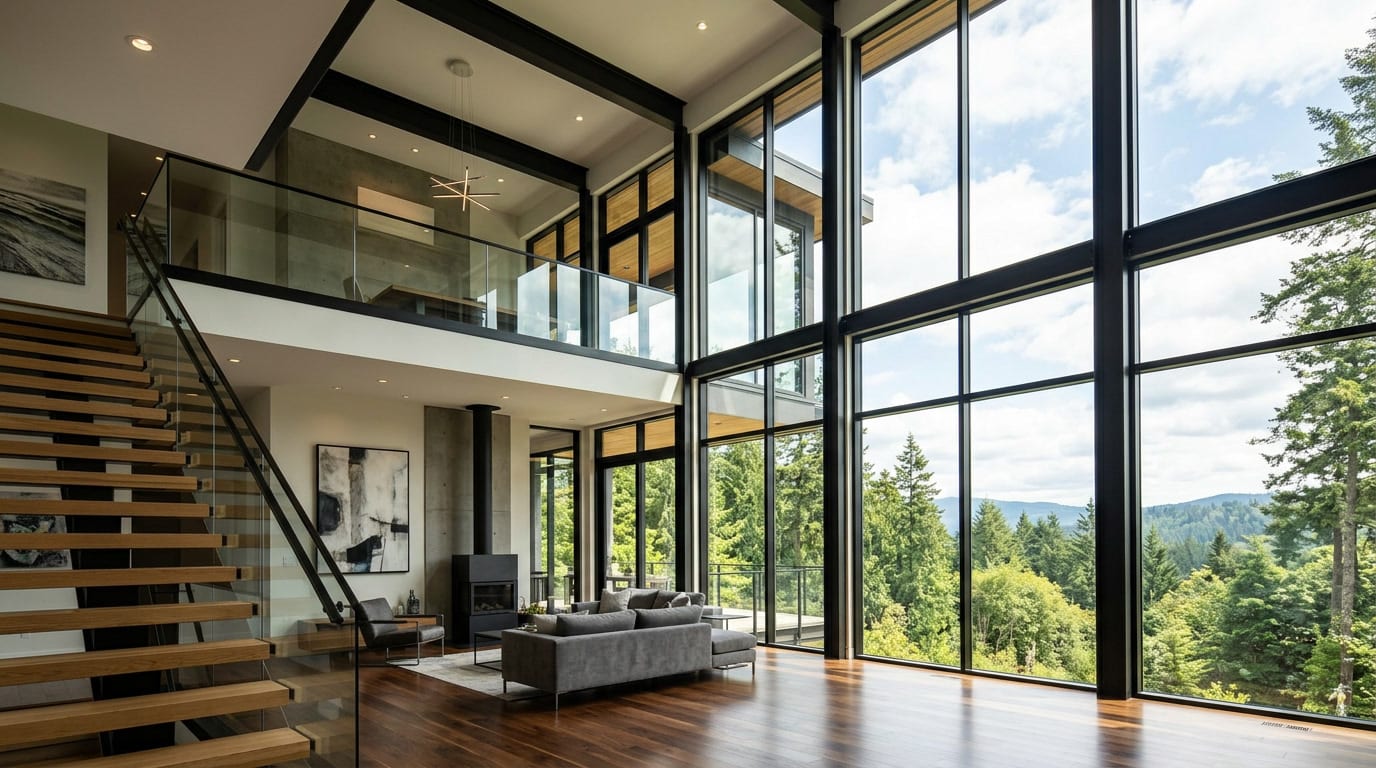
Two-Story and Architectural Glass: Why It Is Not a Ladder Job
A two-story glass wall is one of the defining features of a modern luxury home. Cleaning it well is a question of access and equipment — and it is emphatically not a homeowner-ladder job.
Why height changes everything
At ground level, window cleaning is a matter of technique. Above the first floor it becomes a matter of safe, stable access first and technique second. A ladder leaned against a glass wall is unstable, marks the glass and frame, and reaches only a fraction of a true two-story span. The work done from a precarious position is rushed work, and rushed work on architectural glass shows. Height is also where the genuine safety risk lives — for a homeowner attempting it, and for an underinsured crew improvising it.
Modern architectural glass spans — floor-to-ceiling panels, curtain-wall systems, corner-less glass joints — present additional complexity beyond mere height. The framing profiles are often aluminum or thermally broken steel, both of which scratch at surprisingly low abrasion. The seals at the perimeter are silicone or structural glazing compound that can be loosened by equipment contact or harsh chemistry. A two-story span of glass is not simply a large window — it is a system, and cleaning it correctly means treating it as one.
The equipment that does it properly
Professional height-access falls into a few methods, chosen by the geometry of the home:
- Water-fed poles — carbon-fiber extension poles that reach multiple stories from the ground, delivering purified water that dries spot-free with no squeegee. The standard approach for many architectural facades.
- Scaffold or lift — where geometry, glass detailing, or interior gallery glass requires a person at height rather than a pole.
- Traditional access — where the architecture genuinely permits safe reach.
The method is selected during a pre-visit assessment of the home, not improvised on the day.
Water-fed pole systems: how they work and why they matter
A water-fed pole system delivers water that has been passed through reverse-osmosis and de-ionizing filtration until the dissolved-solids count reaches near zero. At that purity level, water evaporates without leaving the mineral residue that produces spots. There is no squeegee pass, no ladder, and no contact between a brush or tool and the glass frame. The bristles on the pole head are soft nylon or boar-hair; they agitate the glass surface to release contamination, and the pure water rinse carries it away. From the ground, an operator with a well-set-up pole system can clean two or even three stories cleanly and safely.
The limitation is geometry. An interior gallery wall, an atrium, a glass floor insert, or a facade with deep reveals may require a person actually positioned at height. In those cases the next question is how that access is rigged, and what coverage the crew carries for it.
Frame and seal care alongside the glass
Glass is only part of what a two-story window system involves. The aluminum or steel frames, the silicone perimeter seals, the drainage channels, and any sill finishes are all within the scope of proper care and are all capable of being damaged by the wrong approach. Alkaline cleaners that are fine on glass will streak anodized aluminum. Pressure applied directly to a silicone joint at the base of a large pane can lift or crack it. A qualified crew cleans the glass, wipes the frames with a compatible product, and inspects the seals for lifting or cracking while they are working at height — a service visit that also functions as a passive inspection of the window system.
The insurance question
Height work raises the stakes on insurance. A crew cleaning ground-floor windows and a crew cleaning a two-story glass wall are exposed to very different risk, and the coverage should reflect it. Before height work begins on a home, the partner’s liability coverage — including coverage for elevated work — should be verified. A crew that cannot speak to its height-work coverage is the wrong crew for a two-story facade.
Specific language worth asking about: does the general liability policy include or exclude work above a specified height? Some residential cleaning policies carry height exclusions at ten or fifteen feet — which means the policy is void for the very work being performed. An elevated-access specialist or a crew with a commercial-grade policy without height exclusions is the appropriate match for this scope of work.
Interior architectural glass counts too
Height is not only an exterior issue. Clerestory bands, atrium overheads, and interior gallery glass put panes well out of reach inside the home. The same access discipline applies — the interior of a glass-wall home is part of the same scope. Interior elevated glass also has the additional complication of adjacency: the crew is working above furniture, rugs, and finished floors. Proper drop protection and a clear line of communication about what is below the work area should be established before any bucket, squeegee, or pole goes overhead indoors.
Regional considerations: coastal and desert climates
Climate affects both the soil load on architectural glass and the scheduling logic. In coastal California and Florida markets, salt-spray film accumulates on glass within weeks of a cleaning and accelerates corrosion on metal frames if left in contact. The cleaning interval for coastal architectural glass is shorter than for inland properties, and the chemistry must be compatible with the salt-removal task. In desert Arizona markets, the primary enemies are mineral-heavy water from irrigation overspray, fine dust that films the glass during wind events, and the periodic ash and particulate from wildfire smoke. Post-storm and post-fire cleaning cycles are a practical reality for glass-wall homes in those markets, not an unusual request.
Two-story and architectural glass capability, with verified height-work insurance, is a listing requirement for our window partners. See window-cleaning coverage or request a quote.
Why trust this
Guidance held to a published standard.
Clean Freaks Co connects homeowners with window cleaning across Arizona, California, and Florida through approved, insured local partners held to a published vetting standard — partners who hold two-story and elevated-access capability as a documented requirement, not an assumption.
This Journal is written and reviewed to that same standard. Guidance on access methods, frame chemistry, and height-work insurance follows manufacturer specifications and professional trade practice, and defaults to the conservative method when sources diverge. Read how the Journal is written and reviewed.
Questions
Frequently asked.
Can a water-fed pole system clean glass that is more than two stories up?
Most commercial water-fed pole systems reach comfortably to three stories — approximately thirty to forty feet — and some purpose-built rigs extend beyond that. Above three stories, the practical limit shifts from the pole length to the operator’s ability to control the brush head with precision. At that height, a lift or rope-access specialist is typically the correct method.
What is the risk of using a standard extension ladder on a large glass panel?
Several. The feet of a leaned ladder concentrate point-load against the glass or frame and can crack the pane or dent soft aluminum profiles. A ladder is inherently less stable than a scaffold or lift, which means the operator is more likely to steady themselves by pressing against the glass — another crack risk. And the reach from a standard ladder is limited, so the crew tends to rush sections that should receive careful attention.
How often should a two-story glass wall be cleaned professionally?
Twice annually is a reasonable baseline for most markets. Coastal homes in Florida and Southern California accumulate salt film quickly and may benefit from quarterly visits. Arizona homes often add a cleaning after the summer monsoon season when dust and particulate load is highest. Interior gallery glass in a climate-controlled environment typically needs one professional cleaning per year.
What should I ask a window cleaner about their insurance before they clean elevated glass?
Ask for a current certificate of insurance and look specifically at the general liability limit and whether the policy excludes work above a certain height. Some residential policies exclude elevated work at ten or fifteen feet — which voids coverage for the very job being done. Also ask whether workers’ compensation is in place for every person working at height on your property.
Is it safe for a window cleaning crew to walk on a flat glass roof or skylight to access a facade?
Generally no. Flat glass roofs and skylights are not engineered for foot traffic unless they are specifically rated for it — and very few residential skylights are. The appropriate access for a facade that would otherwise require roof-walking is a lift or scaffold positioned at the exterior. A crew that proposes walking on your skylight to reach the facade should be declined.
Related reading
More from the Journal.

For your home
Window care, held to a standard.
When your glass needs a cleaner who works to a verified standard, we connect you with an approved local partner who knows your home before the first visit. See window cleaning coverage, or send the details and your local partner will be in touch.
Request a quote
About Clean Freaks Co
Clean Freaks Co is a premier luxury home cleaning service company that has carved a niche in the cleaning industry with its top-tier services. With a keen focus on luxury homes, we ensure every detail is handled with the utmost care and precision, providing a level of service that goes above and beyond the norm.
Our services are comprehensive and tailored to meet the unique needs of luxury homes. We offer residential cleaning, carpet & floor cleaning, window cleaning, and exterior cleaning. Our team of professionals is committed to providing the highest level of service, ensuring your home is pristine and inviting.
We believe in using natural cleaning products that not only deliver exceptional results but also protect our clients and the environment. Our commitment to eco-friendly cleaning solutions is part of our mission to provide a clean and safe environment for luxury homeowners.
Clean Freaks Co operates in three major states, specifically in Atherton & Los Altos Hills, California; Paradise Valley, Arizona; and Jupiter Island & Golden Beach, Florida. We are proud to serve luxury homeowners in these areas and are dedicated to exceeding our clients' expectations with every service we provide.
Choosing Clean Freaks Co means choosing a team that understands the unique needs of luxury homes. Our attention to detail, commitment to using natural cleaning products, and dedication to providing a superior customer experience set us apart. We take pride in transforming luxury homes into pristine living spaces where our clients can relax and enjoy their surroundings.
For more information or to schedule a service, please contact us at skyler.salterra@gmail.com. We look forward to providing you with a clean and safe environment that you'll love.
Written and published by Clean Freaks Co. How the Journal is written and reviewed →