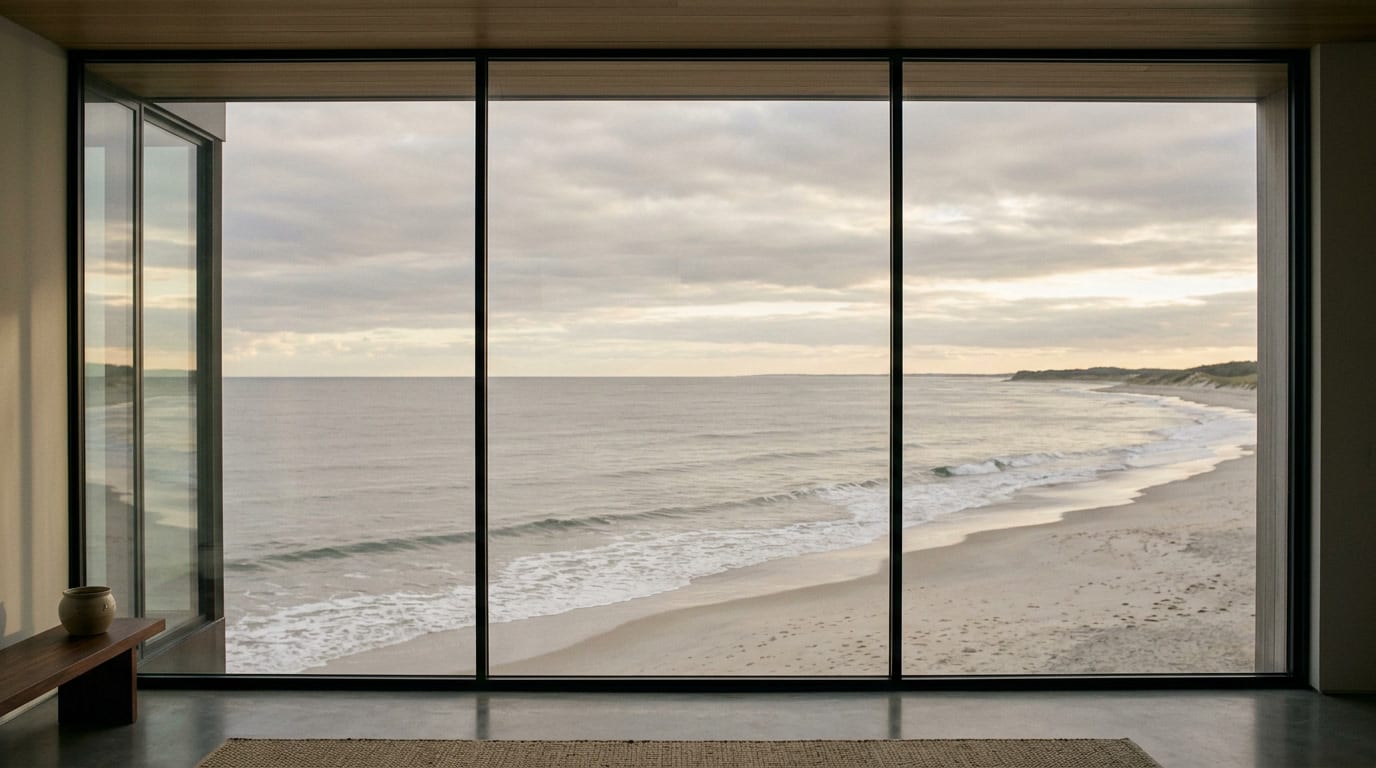
Salt-Spray Film on Coastal Glass: A Different Problem Than Hard Water
Oceanfront glass develops a film that ordinary window cleaner cannot remove and stronger scrubbing only smears. It is salt — and salt is a different chemical problem than the hard-water spotting inland homes deal with.
Salt is not dirt
The film on ocean-facing glass is chloride residue carried in sea spray. As the spray dries on the window, the water evaporates and the salt stays, building a layer that bonds to the glass surface over weeks. A standard window cleaner is a surfactant — it lifts dirt and oil. It has no effect on a bonded chloride film. The cleaner does its job, the salt remains, and the glass looks hazy the moment the light angles across it.
The bonding mechanism matters. Sodium chloride in its hydrated form is relatively easy to remove; as it dries fully and crystallizes against the silica surface of the glass, it forms a mechanical adhesion that surfactants cannot break. On glass that receives direct afternoon sun — west-facing elevations on California and Florida coastlines in particular — the drying and rebonding cycle accelerates. The film on those surfaces after a month without cleaning is not simply dirty; it is chemically adhered.
Why it is not the same as hard water
Inland homes deal with hard-water spotting — calcium and magnesium minerals from the water supply. Coastal homes deal with chloride from the ocean. Both are bonded deposits that resist ordinary cleaner, but they are different compounds and they respond to different chemistry. A product formulated to dissolve hard-water mineral is not necessarily the right product for salt, and vice versa. A window partner who works the coast carries the chloride-specific chemistry; an inland crew working an oceanfront home for the first time often does not.
This is a meaningful practical distinction. Calcium-based mineral deposits are typically removed with mild acid chemistry — citric or oxalic-based products are common. Chloride film responds better to formulations designed to break the chloride bond specifically, often combined with a pH-neutral rinse to prevent streaking. Applying an acid-based mineral remover to a salt-film problem can appear to work initially and leave the glass looking worse at the next light-angle check. The right diagnosis comes before the chemistry selection.
The risk of forcing it
The damage happens when a crew tries to defeat salt film with abrasion — an aggressive pad, a scraper, mechanical force where chemistry should have been used. On any glass that risks scratching; on the coated and tinted glass common in coastal homes it can strip the coating permanently. Salt film yields to the correct dissolver applied with dwell time. It does not need to be forced, and forcing it is how a cleaning becomes a repair bill.
Low-e and solar-control glass coatings are standard on coastal construction for UV and heat management. These coatings sit on the glass surface or between laminations, and they are more sensitive to abrasion and to certain cleaning chemistries than bare float glass. A crew that does not work with coated glass regularly may not know which products are coating-compatible. This is a question worth asking: does the partner know what glass types are in the home, and have they confirmed their chemistry is appropriate for each?
Regional patterns across Arizona, California, and Florida
The salt-film problem varies by coastal geography in ways that affect cleaning approach. Florida’s Gulf Coast tends toward a finer, more pervasive spray carried by prevailing southwest winds; Gulf-facing glass on properties in Naples or Sarasota accumulates consistently across all elevations. Florida’s Atlantic side sees a denser spray on east-facing glass from storm events and sea-breeze cycles. California coastal properties — Malibu, Newport, Laguna — face a different challenge: marine layer fog that deposits moisture and suspended particulate across all glass, not just ocean-facing panes. Arizona has no coastal exposure, but homes near the Salton Sea face a secondary version of the mineral-deposit problem from that water body.
A partner who knows a specific coastal market knows the prevailing exposure pattern for that geography, and can advise on which elevations need the most frequent attention.
Cadence is shorter on the coast
Salt film accumulates fast — within weeks on west-facing ocean glass. Coastal homes generally need a shorter window-cleaning interval than inland ones, and the ocean-facing elevations a shorter interval still. The film is far easier to remove before it fully bonds than after, so the cadence is also a cost decision.
On properties with significant glass area — floor-to-ceiling glazing, clerestory windows, glass balustrades — the accumulation is proportionally larger. A home with 40 feet of ocean-facing glass at the first level may have salt film visible in diffused light within two to three weeks of a clean. Many oceanfront homeowners schedule the ocean-facing elevations on a four- to six-week cycle and the non-ocean elevations quarterly, treating them as two separate maintenance items rather than one blanket schedule.
When the glass is etched, not filmed
There is a point past which the problem is no longer cleaning but restoration. When salt film is left long enough — particularly on glass that also receives hard-water runoff from irrigation or sprinklers — the chloride and mineral deposits can etch the surface itself. Etching is surface pitting at the microscopic level; it scatters light and creates a permanent haze that no amount of cleaning removes. Restoration in that case involves glass polishing compounds and specialized equipment, at a cost well above a routine clean.
A capable window partner can distinguish filming from early etching during the cleaning visit. The honest answer when a surface is etched is to say so, rather than clean it, invoice it, and leave the homeowner wondering why the glass still looks hazy.
Coastal salt-film capability is verified before a window partner is listed for an oceanfront market. See window-cleaning coverage or request a quote.
Why trust this
Guidance held to a published standard.
Clean Freaks Co connects you with window cleaning for high-value oceanfront and coastal homes across California and Florida through approved, insured local partners held to a published standard. Coastal salt-film capability is a verified requirement — not assumed — before a partner is listed for any ocean-facing market.
This Journal is written and reviewed to that same standard. Material guidance on glass chemistry, coating compatibility, and cleaning cadence follows manufacturer and trade sources and defaults to the conservative method. Read how the Journal is written and reviewed.
Questions
Frequently asked.
Can I remove coastal salt film with vinegar or a DIY solution?
White vinegar is mildly acidic and will dissolve some light salt residue if the film is fresh and not yet fully bonded. On glass that has gone several weeks or more without cleaning, the film has typically bonded beyond what a dilute acid rinse can address. Vinegar is also inappropriate for coated or tinted glass, where the acidity can affect the coating over time. For bonded film, a chloride-specific professional product applied with proper dwell time is what works.
How do I know if my glass is coated or tinted in a way that limits cleaning chemistry?
Check your window documentation or the glass manufacturer’s label if accessible — many coated glass panes carry a small etched mark in the corner. A qualified window cleaner can identify low-e and solar-control coatings visually before starting work. If you are uncertain, disclose to your cleaning partner that the glass may be coated and ask them to verify before applying any chemistry beyond standard pH-neutral cleaner.
Why does my oceanfront glass look hazy even right after cleaning?
Persistent haze immediately after cleaning on coastal glass usually indicates one of two things: either the cleaning product was not matched to the salt-film chemistry and the film remains, or the glass has begun to etch — surface-level pitting from prolonged mineral exposure that scatters light regardless of cleaning. A professional can distinguish the two. Etching requires restoration work, not further cleaning.
Does salt film affect window frames and tracks as well as the glass?
Yes, and in some respects more severely. Aluminum frames on coastal homes are subject to galvanic corrosion accelerated by salt exposure; the anodizing or paint layer that protects them needs periodic attention. Window tracks accumulate salt-laden debris that, if left, can pit and seize the hardware. A thorough coastal window service addresses frames and tracks as part of the visit — not only the glass pane.
How much shorter should the window-cleaning interval be for an oceanfront home versus an inland one?
There is no universal number, but a common practical range is every four to eight weeks for ocean-facing elevations versus every three to four months for a comparable inland home. The specific interval depends on the home’s exposure — orientation, elevation, whether there are overhangs or screening plants — and on how much visual haze is acceptable between cleans. A partner familiar with the property can recommend an interval after the first visit.
Related reading
More from the Journal.



For your home
Window care, held to a standard.
When your glass needs a cleaner who works to a verified standard, we connect you with an approved local partner who knows your home before the first visit. See window cleaning coverage, or send the details and your local partner will be in touch.
Request a quote
About Clean Freaks Co
Clean Freaks Co is a premier luxury home cleaning service company that has carved a niche in the cleaning industry with its top-tier services. With a keen focus on luxury homes, we ensure every detail is handled with the utmost care and precision, providing a level of service that goes above and beyond the norm.
Our services are comprehensive and tailored to meet the unique needs of luxury homes. We offer residential cleaning, carpet & floor cleaning, window cleaning, and exterior cleaning. Our team of professionals is committed to providing the highest level of service, ensuring your home is pristine and inviting.
We believe in using natural cleaning products that not only deliver exceptional results but also protect our clients and the environment. Our commitment to eco-friendly cleaning solutions is part of our mission to provide a clean and safe environment for luxury homeowners.
Clean Freaks Co operates in three major states, specifically in Atherton & Los Altos Hills, California; Paradise Valley, Arizona; and Jupiter Island & Golden Beach, Florida. We are proud to serve luxury homeowners in these areas and are dedicated to exceeding our clients' expectations with every service we provide.
Choosing Clean Freaks Co means choosing a team that understands the unique needs of luxury homes. Our attention to detail, commitment to using natural cleaning products, and dedication to providing a superior customer experience set us apart. We take pride in transforming luxury homes into pristine living spaces where our clients can relax and enjoy their surroundings.
For more information or to schedule a service, please contact us at skyler.salterra@gmail.com. We look forward to providing you with a clean and safe environment that you'll love.
Written and published by Clean Freaks Co. How the Journal is written and reviewed →