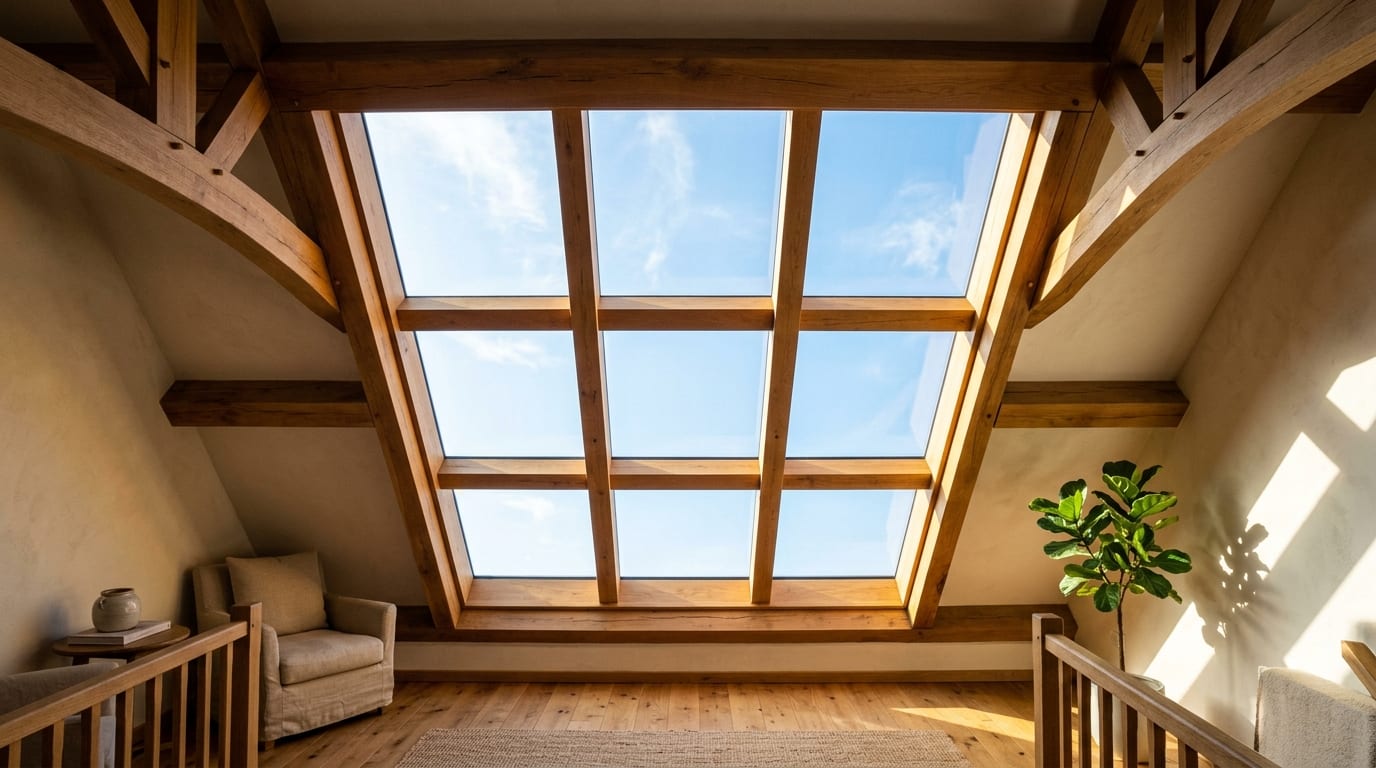
Skylight Cleaning: The Glass That Faces the Worst Weather
A skylight occupies an awkward position in a home — it is a window, but it lives on the roof. That dual nature is why it is so often neglected, and why it needs a specific approach.
The glass that faces the worst weather
Of all the glass in a home, the skylight takes the most punishment. It faces straight up — into full sun, falling debris, pollen, dust, and standing rain. It accumulates faster than any vertical window and, because it is overhead and out of the daily eyeline, it is noticed last. By the time a skylight looks visibly dirty from inside, it has usually been collecting for a long time.
The accumulation profile of a horizontal or near-horizontal glass surface is fundamentally different from a vertical window. Vertical glass sheds most rainfall and wind-carried debris; skylights collect it. Pollen, leaf particulate, bird activity, airborne dust, and the mineral residue left by rain evaporation all stay where they land. In desert climates like Phoenix and Scottsdale, the mineral residue from hard water in rain is a particular problem — each rainfall deposits a fine mineral film as the water evaporates on a warm glass surface. Over a season of monsoon rain, these deposits build into a haze that significantly reduces natural light transmission.
The seal is as important as the glass
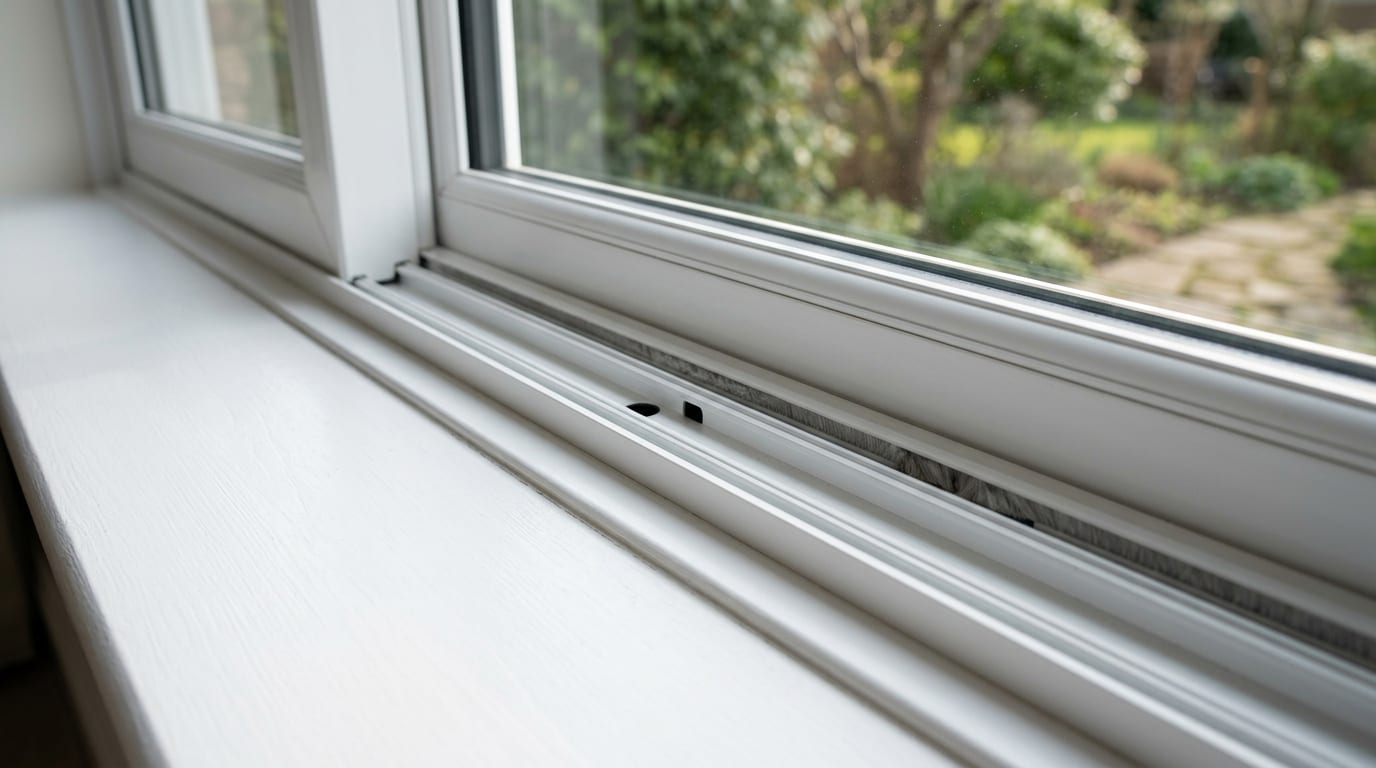
Cleaning a skylight is not only about the glass. Skylights are sealed into the roof with gaskets, flashing, and rubber surrounds, and those seals are the most failure-prone part of the assembly. A capable cleaner treats the visit as an inspection as well: clouding or condensation between panes is a sign of a failed seal, not a cleaning problem, and a homeowner is far better off learning that during a routine clean than during a leak. The cleaning chemistry must also be chosen so it does not migrate into and degrade the gasket.
Gasket degradation from incompatible cleaning chemistry is a slow failure mode that is easy to miss. Many standard window cleaning solutions are fine on glass but contain surfactants or solvents that soften rubber compounds over repeated exposure. A professional who works on skylights regularly knows which products are gasket-safe and applies them accordingly — keeping chemistry on the glass and away from the perimeter seal. This distinction matters more on older skylights where the gasket may already be showing age.
The inspection component also extends to the flashing — the metal seal between the skylight frame and the roofing material. Flashing that has lifted, corroded, or lost its lap joint seal is a leak in progress. It is not visible from inside until the leak is active, but it is visible from roof level during a cleaning visit. A cleaner who notes flashing concerns during the inspection provides information the homeowner can act on before it becomes a water intrusion event.
Glass types in skylight construction
Skylights use specialized glass that requires specific chemical awareness. Tempered glass is standard for safety and is reasonably robust to cleaning chemistry, but it is susceptible to glass-surface scratching from abrasive pads. Laminated glass — two layers bonded with a PVB interlayer — is increasingly common in premium residential skylights for its security and acoustic properties; the edge where the interlayer is exposed is sensitive to moisture intrusion and must be kept dry during cleaning. Low-e coated skylights are common in climates where solar heat gain is a concern — Arizona and California in particular — and those coatings require the same chemistry caution as coated vertical windows: no ammonia, no alkaline strippers.
Polycarbonate skylights — more common in older construction and in some contemporary design applications — are a different category entirely. Polycarbonate scratches easily, cannot tolerate solvent-based cleaners, and requires specific gentle chemistry and soft application tools. A professional who does not confirm the glazing material before selecting chemistry risks damaging a polycarbonate surface with a product that would be entirely appropriate on glass.
Access is roof access
Reaching a skylight means working on or over a roof. That is its own discipline — roof-safe technique, fall protection where the pitch requires it, and equipment that does not damage roofing material. Pole-fed cleaning from a stable position handles many skylights; steeper or more complex roofs require proper roof-access protocol. As with all height work, the partner’s insurance should cover it.
Tile roofs — common in Arizona, California, and Florida residential construction — present a specific access concern. Tile is fragile and load-sensitive; walking on it without a plan for weight distribution can crack tiles that are not visible from the ground. A crew that knows roof access knows not to walk directly on tile, where to distribute weight along the load-bearing structure, and how to reach a skylight without routing across active tile fields. This is experience-dependent knowledge, and it is worth asking about specifically before a first visit on a tile-roofed property.
Cadence
Because skylights soil faster than vertical glass, they often warrant their own interval. Many homeowners scope the skylights on the same recurring visit as the rest of the windows; in skylight-heavy homes — Eichler and transitional architecture in particular — it is a standard line item rather than an occasional extra.
In practice, the right cadence depends on what the skylight faces and what it collects. A north-facing skylight in a well-sheltered roof plane accumulates slowly and may need cleaning only twice a year. A south-facing skylight on an exposed roof in a desert climate, or one directly beneath a large tree, may need attention four to six times a year to maintain useful light transmission. The inspection that happens at the first professional cleaning visit — where a qualified crew can assess the exposure, the glass type, and the current accumulation rate — is the right basis for a cadence recommendation.
Skylight cleaning, with seal-aware technique and roof-access discipline, is verified capability for our window partners. See window-cleaning coverage or request a quote.
Why trust this
Guidance held to a published standard.
Clean Freaks Co connects homeowners with window and skylight cleaning across Arizona, California, and Florida through approved, insured local partners held to a published standard. Skylight capability — roof-access discipline, seal-aware technique, and glass-type-specific chemistry — is verified before any window partner is listed.
This Journal is written and reviewed to that same standard. Material guidance on skylight glazing types, seal inspection, and access methods follows manufacturer and trade sources and defaults to the conservative method. Read how the Journal is written and reviewed.
Questions
Frequently asked.
Can condensation between skylight panes be fixed by cleaning?
No. Condensation or fogging between panes means the sealed unit has failed — the inert gas fill has escaped and moisture has entered the gap between the glass layers. That is a glazing replacement, not a cleaning problem. A professional who notices this during a cleaning visit should tell you plainly rather than clean around it. Attempting to clean the interior of the glass cavity is not possible without disassembly.
Is it safe to clean a skylight from inside with a long-handled tool?
You can remove surface dust from the interior glass face, but interior cleaning addresses only one side of the glass. The exterior is where the accumulation is worst — mineral deposits, pollen, biological debris — and that requires exterior access. Interior cleaning is useful maintenance between professional visits but is not a substitute for exterior cleaning, particularly on the exterior face where mineral and organic buildup requires chemistry and proper technique.
Does skylight cleaning damage the roof or void a roofing warranty?
Competent skylight cleaning by a crew trained in roof access does not damage the roof. Damage occurs when crews without roof experience walk on tile incorrectly, use equipment that impacts the roofing surface, or route water in ways that saturate the underlayment. The question to ask a prospective crew is not whether they can reach the skylight, but whether they have specific experience working on the roof type your home has — flat foam, concrete tile, clay tile, and shingle all require different protocols.
My skylight looks clean from inside but still seems dim. What is causing that?
Two likely causes: the exterior glass surface has a mineral or organic film that diffuses rather than blocks light — you may not see it as a distinct haze, but it reduces transmission measurably; or the low-e coating on the glass is working as intended by blocking solar heat, which inherently reduces some visible light transmission. A professional cleaning visit will tell you quickly whether the issue is surface contamination or the glass properties themselves.
How should skylight cleaning be scoped — as part of the window cleaning visit or separately?
Either approach works, but the practical consideration is access and sequencing. If the skylight cleaning requires different equipment or a second crew member for roof safety, the visit may need to be longer or structured differently than a standard window call. For homes with multiple skylights or complex roof geometry, discussing scope explicitly before the first visit — rather than discovering it on the day — produces a better result and a more accurate estimate.
Related reading
More from the Journal.


For your home
Window care, held to a standard.
When your glass needs a cleaner who works to a verified standard, we connect you with an approved local partner who knows your home before the first visit. See window cleaning coverage, or send the details and your local partner will be in touch.
Request a quote
About Clean Freaks Co
Clean Freaks Co is a premier luxury home cleaning service company that has carved a niche in the cleaning industry with its top-tier services. With a keen focus on luxury homes, we ensure every detail is handled with the utmost care and precision, providing a level of service that goes above and beyond the norm.
Our services are comprehensive and tailored to meet the unique needs of luxury homes. We offer residential cleaning, carpet & floor cleaning, window cleaning, and exterior cleaning. Our team of professionals is committed to providing the highest level of service, ensuring your home is pristine and inviting.
We believe in using natural cleaning products that not only deliver exceptional results but also protect our clients and the environment. Our commitment to eco-friendly cleaning solutions is part of our mission to provide a clean and safe environment for luxury homeowners.
Clean Freaks Co operates in three major states, specifically in Atherton & Los Altos Hills, California; Paradise Valley, Arizona; and Jupiter Island & Golden Beach, Florida. We are proud to serve luxury homeowners in these areas and are dedicated to exceeding our clients' expectations with every service we provide.
Choosing Clean Freaks Co means choosing a team that understands the unique needs of luxury homes. Our attention to detail, commitment to using natural cleaning products, and dedication to providing a superior customer experience set us apart. We take pride in transforming luxury homes into pristine living spaces where our clients can relax and enjoy their surroundings.
For more information or to schedule a service, please contact us at skyler.salterra@gmail.com. We look forward to providing you with a clean and safe environment that you'll love.
Written and published by Clean Freaks Co. How the Journal is written and reviewed →