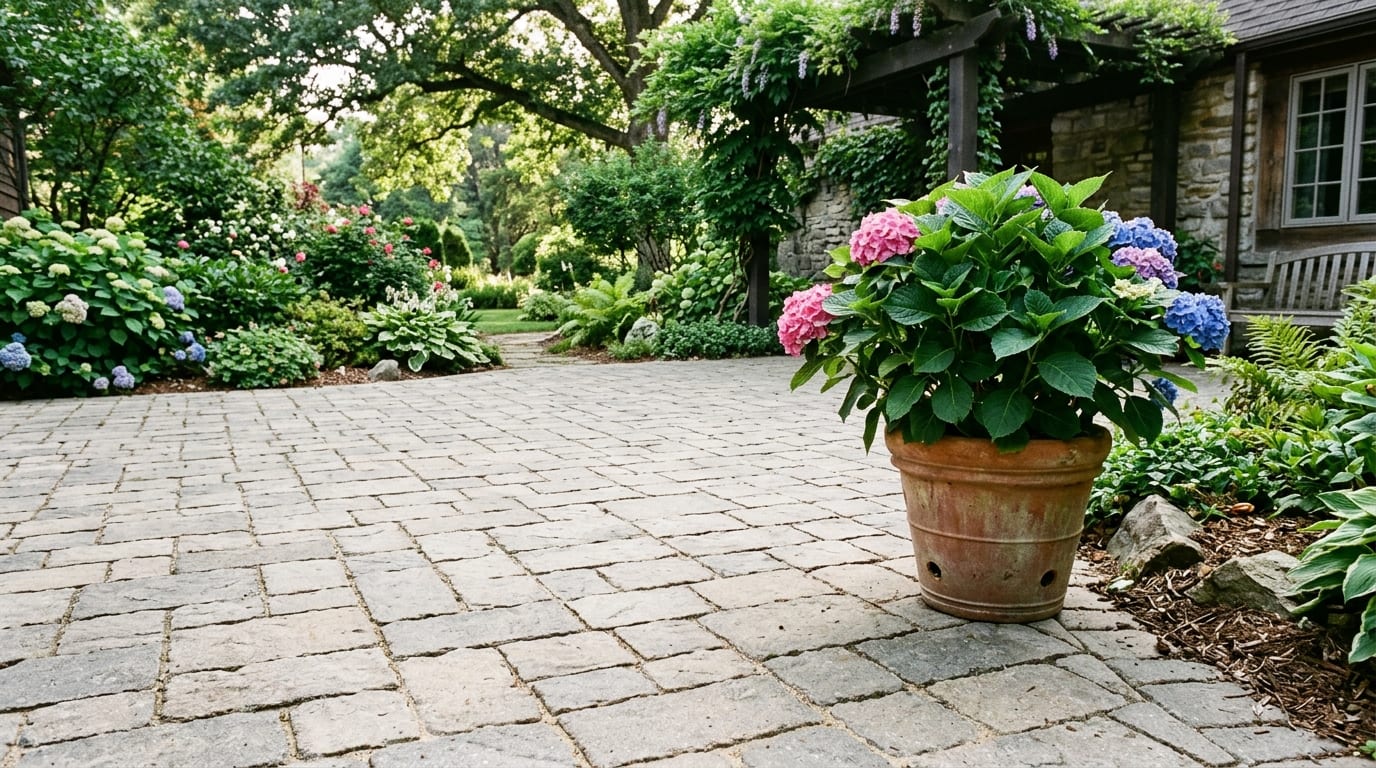
Paver Patios: Joint Sand, Biological Staining, and Why Both Matter
A paver patio is not a solid surface — it is a field of individual stones held in place by the sand between them. Cleaning it well means respecting both the stones and the sand.
The joint sand is structural
The sand packed into the joints between pavers is not a finishing detail. It is what locks the pavers together, distributes load, and keeps individual stones from shifting and rocking. When that sand washes out, the patio loosens — pavers move underfoot, edges lift, and the field slowly loses its integrity. Any cleaning method that strips the joint sand is trading a clean patio today for a failing one later.
The consequence of lost joint sand is not always immediately visible. A patio can lose a significant portion of its joint-sand depth before individual pavers begin to rock noticeably — but the structural vulnerability is established before the movement becomes obvious. Water now has a clear path into the joint, where it accelerates the biological growth cycle and, in climates with any freeze-thaw cycle, contributes to frost heaving. In Florida and coastal California the absence of freeze-thaw does not eliminate the problem: water infiltrating deep joints in a humid climate encourages root intrusion from adjacent plantings, which is among the most damaging long-term threats to a paver installation.
How aggressive cleaning strips it
This is the central tension in paver cleaning. Pavers themselves are durable and can take a fair amount of pressure. The sand between them cannot. A crew that simply turns the pressure up to lift staining quickly will blast the joint sand out along with the soil. The patio looks clean and is structurally worse off. The skill is cleaning the stone effectively while keeping pressure off the joints — and reseating sand where some loss was unavoidable.
The failure mode here is common precisely because pavers are relatively tolerant of pressure. A crew accustomed to cleaning concrete or brick will approach a paver patio with the same technique and equipment setting, not recognizing that the variable they need to manage is not the paver face but the joint between them. Surface cleaners with appropriate spin bar design distribute pressure and are gentler on joints than a direct wand — but they still require appropriate PSI calibration, and in heavy-staining areas a crew may be tempted to dwell too long or increase pressure when staining resists, which is exactly when joint sand loss accelerates.
The biological-staining layer
The other half of paver cleaning is the staining itself. Much of what darkens a paver patio — especially in shaded or damp areas, under canopy, near plantings — is biological growth: algae, moss, and mildew with roots in the porous edges of the stone. Pressure removes the visible layer; the growth returns. The lasting result comes from pre-treatment chemistry that kills the growth at the root, with controlled cleaning to follow. This is why a capable paver cleaning leads with chemistry, not force.
The distinction between removing the visible surface of biological growth and eliminating the growth matters practically. Algae cleaned from a paver face without a biocidal pre-treatment will regrow from the spores left in the joint sand and the microscopic surface porosity of the stone. In a humid Florida environment, visible re-greening can begin within weeks of a pressure-only clean. In Arizona, regrowth is slower but not absent — the shaded areas under covered patios and near water features maintain enough moisture for algae to persist. Pre-treatment chemistry, with adequate dwell time before the pressure step, is what changes the time-to-regrowth from weeks to months or longer.
The correct sequence
- Inspect — paver material, joint sand level, sealer status, staining type.
- Pre-treat — chemistry for biological growth, with dwell time, so pressure does less of the work.
- Clean — pressure calibrated to lift staining without stripping joints.
- Reseat joint sand — replace sand the cleaning dislodged, restoring the patio’s structure.
Polymeric sand versus standard jointing sand
When joint sand is reseated after cleaning, the choice of sand type matters. Standard kiln-dried jointing sand is the conventional material, but polymeric sand — which contains a binder that activates on wetting and hardens as it dries — offers significantly better resistance to washout and weed intrusion between cleanings. It is more expensive and requires careful installation: too much water during activation washes the binder out of the joints, and too little means the binder does not set fully. Applied correctly, polymeric sand can extend the interval between joint-sand reapplication substantially. It is worth discussing with the cleaning crew as part of the post-cleaning sand conversation, not as an afterthought.
A note on resealing
If the patio is to be resealed, it must be genuinely clean and the joint sand restored first — sealer locks in whatever is underneath it. A capable partner flags the sealer conversation as a separate, honest decision rather than bundling it in.
Sealer type also affects the patio’s appearance and maintenance profile going forward. Wet-look sealers darken the paver color and add sheen; natural-look sealers preserve the original appearance while providing protection; penetrating sealers do not change appearance at all but provide the most breathable protection for the stone. Each has applications where it is appropriate and contexts where it is not. A crew bundling sealer into the cleaning quote without discussing these options is making an aesthetic decision that belongs to the homeowner.
Paver care — joint sand and staining both — is a defined scope our pressure-washing partners handle. See pressure-washing coverage or request a quote.
Why trust this
Guidance held to a published standard.
Clean Freaks Co connects homeowners with paver patio cleaning across Arizona, California, and Florida through approved, insured local partners held to a published standard — one that addresses joint-sand preservation, biological pre-treatment, and post-cleaning sand restoration as required steps rather than optional add-ons.
This Journal is written and reviewed to that same standard. Guidance on pressure calibration, polymeric sand, and sealer selection follows hardscape-industry trade sources and paver manufacturer specifications, and defaults to the conservative approach when methods conflict. Read how the Journal is written and reviewed.
Questions
Frequently asked.
How do I know if my paver joints need sand replaced before or after cleaning?
Look at the joint depth relative to the paver face — if the sand surface is more than a quarter inch below the top of the paver, meaningful sand has been lost and the joint needs restoration. You can also press a paver lightly with your foot in a few spots across the patio: movement or any rocking feel indicates that sand loss has already reached a structurally relevant level. A pre-cleaning inspection by the crew should include checking joint-sand depth across the patio and flagging areas of loss before the first wand pass.
What is polymeric sand, and is it worth the extra cost compared to standard jointing sand?
Polymeric sand contains a polymer binder that activates when wetted and hardens as the sand dries, locking the joints more firmly than plain kiln-dried sand. The benefits are meaningful: significantly better resistance to washout during rain and cleaning events, reduced weed germination in the joints, and improved resistance to ant and insect disruption. It is more expensive and requires careful installation — the activation wetting step must be done correctly or the binder does not set. For a patio that will be reseated after cleaning anyway, polymeric sand is usually worth considering, particularly in Florida where rainfall and humidity work against standard sand stability.
Why does my paver patio turn green again within a few weeks of cleaning?
Rapid regrowth of algae after cleaning is the characteristic result of a pressure-only clean that removed the visible surface of the growth without killing it at the biological level. Algae spores remain in the joint sand, in the micro-porosity of the paver face, and on any surface the pressure wand did not reach at sufficient force. Pre-treatment with a biocidal or bleach-based solution — applied before the pressure step with adequate dwell time, typically fifteen to thirty minutes — kills the growth before pressure removal, which extends the clean interval substantially. A crew that does not pre-treat is not cleaning the problem, only cleaning the evidence of it.
Can pavers be damaged by pressure washing, and what does that damage look like?
Concrete pavers can show surface erosion at high pressure, visible as a roughened or pitted texture on the paver face. Natural stone pavers — travertine, bluestone, sandstone — are generally more vulnerable and can show tracking marks, surface spalling, or edge chipping if cleaned at PSI settings appropriate for concrete. The damage is most likely at joints and edges, where the concentrated stream has less paver mass to absorb it. Appropriate pressure for concrete pavers is generally in the 1,500 to 2,500 PSI range; natural stone patios should be cleaned at the lower end or below, with chemistry doing more of the work.
Should I seal my paver patio, and how do I choose between sealer types?
Sealing is optional and the decision should be made deliberately rather than by default. Sealers protect against stain penetration, slow biological growth, and in the case of concrete pavers, preserve color. The tradeoff is that sealers require reapplication every two to four years and, if applied over a patio that is not genuinely clean and properly jointed, lock in the problems underneath. Sealer type — wet-look, natural-look, or penetrating — is primarily an aesthetic choice about how the finished patio should appear. Wet-look sealers add visible sheen and darken color; natural-look preserve the unsealed appearance; penetrating sealers are invisible. The right choice is the owner’s preference, made with full information.
Related reading
More from the Journal.



For your home
Exterior cleaning, calibrated to the surface.
Travertine, stucco, pavers, and pool decks each ask for a different method — and the wrong pressure does damage that does not reverse. We connect you with an approved local partner calibrated to your surfaces. See pressure washing coverage, or send the details and your local partner will be in touch.
Request a quote
About Clean Freaks Co
Clean Freaks Co is a premier luxury home cleaning service company that has carved a niche in the cleaning industry with its top-tier services. With a keen focus on luxury homes, we ensure every detail is handled with the utmost care and precision, providing a level of service that goes above and beyond the norm.
Our services are comprehensive and tailored to meet the unique needs of luxury homes. We offer residential cleaning, carpet & floor cleaning, window cleaning, and exterior cleaning. Our team of professionals is committed to providing the highest level of service, ensuring your home is pristine and inviting.
We believe in using natural cleaning products that not only deliver exceptional results but also protect our clients and the environment. Our commitment to eco-friendly cleaning solutions is part of our mission to provide a clean and safe environment for luxury homeowners.
Clean Freaks Co operates in three major states, specifically in Atherton & Los Altos Hills, California; Paradise Valley, Arizona; and Jupiter Island & Golden Beach, Florida. We are proud to serve luxury homeowners in these areas and are dedicated to exceeding our clients' expectations with every service we provide.
Choosing Clean Freaks Co means choosing a team that understands the unique needs of luxury homes. Our attention to detail, commitment to using natural cleaning products, and dedication to providing a superior customer experience set us apart. We take pride in transforming luxury homes into pristine living spaces where our clients can relax and enjoy their surroundings.
For more information or to schedule a service, please contact us at skyler.salterra@gmail.com. We look forward to providing you with a clean and safe environment that you'll love.
Written and published by Clean Freaks Co. How the Journal is written and reviewed →