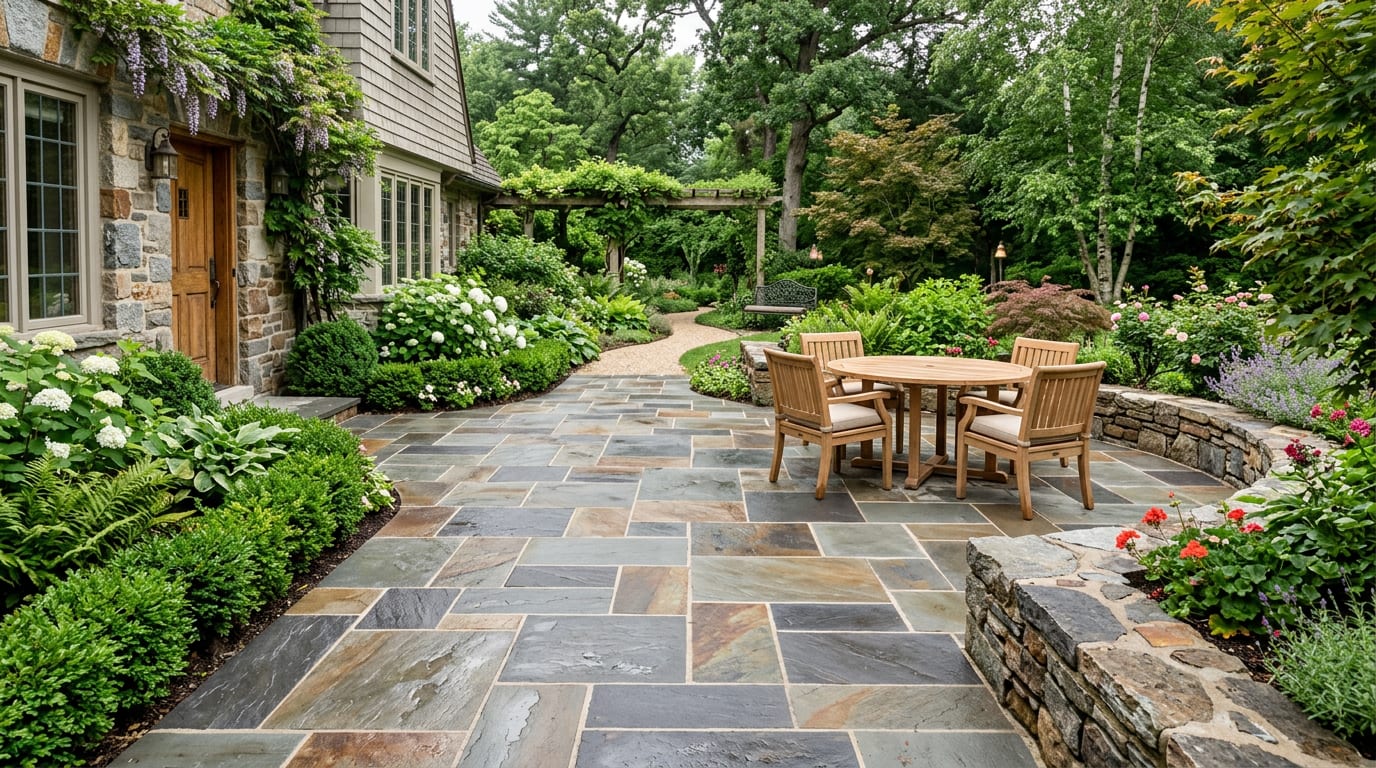
Natural Stone Patios: Why Slate, Bluestone, and Sandstone Each Clean Differently
“Natural stone” is not a single material. A slate patio, a bluestone terrace, and a sandstone walkway are three different stones — and cleaning one as if it were another is how stone gets damaged.
Stone is not interchangeable
Natural stone varies enormously in the qualities that matter for cleaning: porosity, hardness, and how it responds to chemistry. A method that is correct for a dense, hard stone can erode or stain a softer, more porous one. The first task in any stone-patio cleaning is identification — knowing exactly what stone is underfoot, and often more than one stone within a single patio.
Identification is not always straightforward. Many homeowners know their patio was “bluestone” or “travertine” from when it was installed, but the terms are used loosely in the trade, and different geological sources for nominally the same stone can produce material with different porosity and acid sensitivity. A capable crew does not accept the homeowner’s label at face value — they inspect, and when there is uncertainty, they test chemistry on an inconspicuous area before proceeding.
The common stones, briefly
- Slate — layered and prone to flaking if treated harshly; the natural surface can be lifted away by aggressive pressure. Gentle method, careful chemistry.
- Bluestone — relatively dense and durable, but its color can be dulled by the wrong chemistry, and it shows efflorescence (a white mineral bloom) that needs specific treatment.
- Sandstone — porous and comparatively soft; it absorbs readily, stains readily, and erodes under pressure that harder stone would shrug off.
- Limestone and travertine — soft, acid-sensitive; many common cleaning chemistries will etch them.
- Granite — hard and forgiving, the most tolerant of the group.
Acid is the hidden hazard
Many general-purpose exterior cleaning products are mildly acidic. On algae-stained concrete that is fine. On acid-sensitive stone — limestone, travertine, marble, some sandstones — it causes etching: a dull, roughened patch where the acid dissolved the surface. Etching does not clean off. It is permanent. A crew that reaches for the same product on every patio will eventually etch a stone that could not take it.
The frequency with which this error occurs is not hypothetical. Travertine patios are common in Arizona and coastal California — the stone suits the aesthetic and the climate — and travertine is among the most acid-sensitive materials a crew is likely to encounter. A mildly acidic concrete cleaner applied to a travertine patio will etch the surface within minutes. The damage is visible immediately in some lights and can take months to become obvious in others, by which point the crew is long gone and the connection between the cleaning and the damage is disputed. The only protection is a crew that knows what it is cleaning before it starts.
Pressure: how much is too much
Pressure is a variable that must be calibrated per stone type, not set once and applied uniformly. Granite will tolerate 2,500 PSI without consequence. Slate, sandstone, and some travertines will begin to erode, delaminate, or have their surface layers lifted at a fraction of that. The industry term for pressure-related surface damage to stone is “tracking” — the visible stripes left by a wand moved too quickly or at too great a pressure, where the force has physically removed material from the stone face. Tracking on a patio is a permanent record of an error that cannot be undone.
Soft stones are most safely approached with a surface cleaner attachment, which distributes pressure evenly and reduces the concentrated impact of a direct wand, and with the equipment set at the low end of the range appropriate for the material. The goal is to let the chemistry do the lifting and use the pressure only to rinse what the chemistry has loosened.
How a capable crew approaches it
Identification per area of the patio. Chemistry selected for the most sensitive stone in the work zone, tested on an inconspicuous spot first. Pressure calibrated low for soft and layered stone. Joints — sand, mortar, or open — handled appropriately. And an honest read on sealer: many stone patios are sealed, and the sealer’s condition shapes both the cleaning and whether resealing is worth raising.
Regional considerations in Arizona, California, and Florida
Each market has surface conditions that shape the cleaning problem. In Arizona, the primary exterior stone challenges are dust accumulation, mineral-rich hard-water deposit from irrigation overspray, and UV bleaching of sealed surfaces. In coastal California and Florida, the dominant issue is biological growth — algae, mold, and lichen — which establishes quickly in humid and shaded conditions and roots into porous stone surfaces. Lichen in particular requires specific treatment: it bonds to stone through a holdfast structure and cannot be removed by pressure alone without mechanical damage; a biocide treatment, dwell time, and careful removal is the correct approach. A crew that is accustomed to Arizona dust cleaning is not automatically prepared for Florida lichen on travertine.
Natural-stone patio cleaning, identified and calibrated per material, is verified capability for our partners. See pressure-washing coverage or request a quote.
Why trust this
Guidance held to a published standard.
Clean Freaks Co connects homeowners with natural stone patio cleaning across Arizona, California, and Florida through approved, insured local partners held to a published standard — one that requires material identification before chemistry selection and mandates a test patch on any acid-sensitive surface before a full clean begins.
This Journal is written and reviewed to that same standard. Guidance on stone chemistry, pressure calibration, and acid-sensitivity follows the Marble Institute of America and pressure-washing industry trade sources, and defaults to the conservative position in every case where methods conflict. Read how the Journal is written and reviewed.
Questions
Frequently asked.
How do I know if my patio stone is acid-sensitive before a crew arrives?
Limestone, travertine, and marble are the most commonly acid-sensitive stones used in residential patios. If your patio was described to you as any of these, treat it as acid-sensitive until a crew confirms otherwise. A simple field test — a drop of diluted white vinegar applied to an inconspicuous area — will fizz visibly on reactive stone, which confirms acid sensitivity. A capable crew will do this or an equivalent test before selecting their cleaning chemistry.
What is efflorescence, and does it mean something is wrong with the stone?
Efflorescence is a white or chalky deposit that appears on stone or masonry surfaces when water moves through the material and carries dissolved salts to the surface, where the water evaporates and the salts remain. It is not an indication of damage to the stone itself — it is a moisture-movement phenomenon. It is removed with a specific efflorescence cleaner, not with acid (which would etch sensitive stone) and not with pressure alone (which generally cannot dissolve the salt deposit). Recurring efflorescence suggests ongoing moisture migration and may warrant investigation of drainage or waterproofing.
Can lichen on a stone patio be removed without damaging the stone surface?
Yes, but it requires the correct sequence. Lichen attaches to stone through a holdfast structure that pressure alone cannot remove without mechanically damaging the surface. The correct approach is a biocide or bleach-based treatment applied to kill the lichen, followed by a dwell period of several days to weeks depending on the product, after which the dead lichen can be removed with significantly less pressure and mechanical risk. Attempting to pressure-wash live lichen off sensitive stone without prior treatment typically damages the stone and leaves lichen fragments that regrow.
Should a stone patio be sealed after cleaning, and how do I know if mine currently has a sealer?
Whether to seal depends on the stone type, the existing sealer condition, and the owner’s preference for the final appearance — some sealers add sheen, others are matte, and some owners prefer the natural unsealed look. To check for an existing sealer, drip a small amount of water on the surface: if it beads, sealer is present; if it absorbs quickly and darkens the stone, the surface is either unsealed or the sealer has failed. A cleaning crew raising the sealer conversation should treat it as a separate decision with its own timeline, not something to bundle into the cleaning visit without the owner’s deliberate consideration.
Is there a difference between how Arizona and Florida stone patios should be maintained?
Yes, and the difference is primarily biological. Florida’s humidity creates conditions for rapid algae, mold, and lichen growth, particularly on shaded or north-facing surfaces. Arizona patios face more mineral and dust accumulation and UV-related sealer degradation, but biological growth is less aggressive in the arid climate. Florida patios may require more frequent cleaning, a biocide component in the cleaning protocol, and potentially an algaecide additive in the sealer if one is applied. A maintenance cadence appropriate for an Arizona travertine patio will likely be insufficient for the same stone in a Florida climate.
Related reading
More from the Journal.


For your home
Exterior cleaning, calibrated to the surface.
Travertine, stucco, pavers, and pool decks each ask for a different method — and the wrong pressure does damage that does not reverse. We connect you with an approved local partner calibrated to your surfaces. See pressure washing coverage, or send the details and your local partner will be in touch.
Request a quote
About Clean Freaks Co
Clean Freaks Co is a premier luxury home cleaning service company that has carved a niche in the cleaning industry with its top-tier services. With a keen focus on luxury homes, we ensure every detail is handled with the utmost care and precision, providing a level of service that goes above and beyond the norm.
Our services are comprehensive and tailored to meet the unique needs of luxury homes. We offer residential cleaning, carpet & floor cleaning, window cleaning, and exterior cleaning. Our team of professionals is committed to providing the highest level of service, ensuring your home is pristine and inviting.
We believe in using natural cleaning products that not only deliver exceptional results but also protect our clients and the environment. Our commitment to eco-friendly cleaning solutions is part of our mission to provide a clean and safe environment for luxury homeowners.
Clean Freaks Co operates in three major states, specifically in Atherton & Los Altos Hills, California; Paradise Valley, Arizona; and Jupiter Island & Golden Beach, Florida. We are proud to serve luxury homeowners in these areas and are dedicated to exceeding our clients' expectations with every service we provide.
Choosing Clean Freaks Co means choosing a team that understands the unique needs of luxury homes. Our attention to detail, commitment to using natural cleaning products, and dedication to providing a superior customer experience set us apart. We take pride in transforming luxury homes into pristine living spaces where our clients can relax and enjoy their surroundings.
For more information or to schedule a service, please contact us at skyler.salterra@gmail.com. We look forward to providing you with a clean and safe environment that you'll love.
Written and published by Clean Freaks Co. How the Journal is written and reviewed →