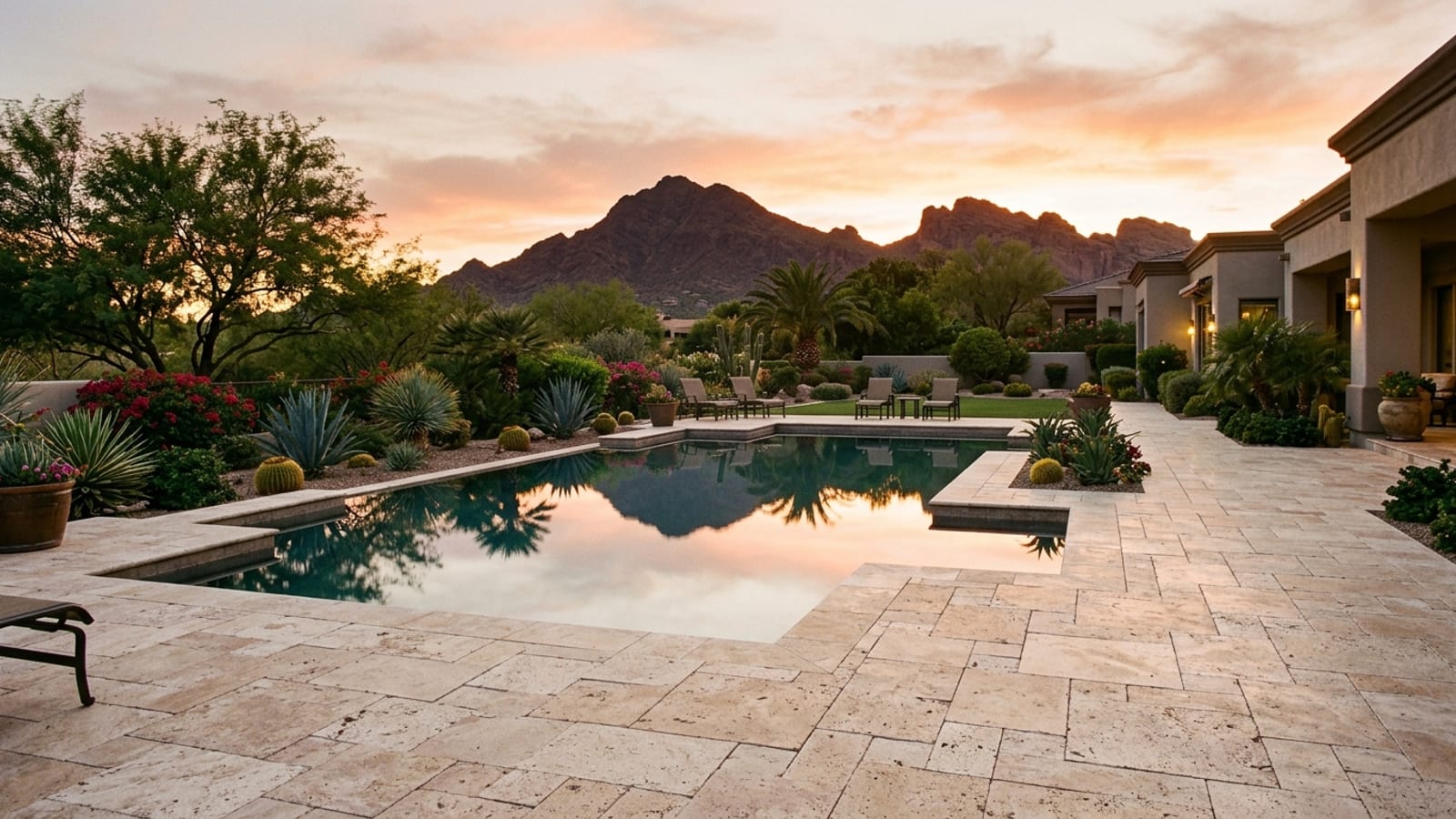
Pressure Washing in Paradise Valley: Travertine, Pavers, and Pool Decks
Pressure washing in Paradise Valley means working with travertine, pavers, flagstone, exposed aggregate, and stucco — surfaces that respond very differently to water pressure. The work is calibration and chemistry, not raw force. A generic contractor running a single pressure setting across all of them will cause damage.
Why Paradise Valley exteriors are not a standard pressure-washing job
Most Paradise Valley properties were built with stone and masonry that performs beautifully underfoot and on pool decks but is genuinely intolerant of the wrong cleaning approach. Travertine is porous and soft relative to harder stone; high pressure etches the surface, opens the pores, and accelerates future soiling. Pavers rely on polymeric joint sand to stay stable; aggressive pressure blows that sand out, loosening the entire field. Flagstone and exposed aggregate have textured surfaces where a too-close nozzle removes material rather than soil.
The phrase “pressure washing paradise valley” describes a category of work that looks simple — point a wand, pull the trigger — but the calibration required for these surfaces is the actual skill. A contractor who arrives with one nozzle, one pressure setting, and no knowledge of the substrate will produce results that look acceptable for a week and create restoration costs for months.
Travertine: the surface most commonly damaged
Travertine is the dominant pool-deck and patio material across Paradise Valley, and it is the surface most often harmed by careless pressure washing. Its open, vascular structure means it absorbs cleaning solutions and holds moisture. High-pressure water drives soil deeper into the voids rather than lifting it, then strips the surface over time.
The correct approach on travertine is soft washing: a controlled, low-pressure application of an appropriate cleaning solution that breaks down biological growth, body oils, and sunscreen residue at the molecular level, followed by a gentle rinse that moves the suspended soil off the surface without eroding the stone. The result is a genuinely clean surface rather than a blasted one.
A further consideration: many travertine pool decks in Paradise Valley have been filled and sealed. High pressure voids the seal, opens the fill, and forces you into a resealing project. The partner doing the cleaning needs to know what they are working with before they start.
Pavers: joint sand is the critical variable
Paver driveways, courtyards, and pool decks depend on their joint sand for structural integrity. Polymeric joint sand hardens and locks the field; once it is gone, pavers shift, tip, and hold standing water in the gaps. Replacing joint sand is labor-intensive and expensive.
Pressure washing paradise valley paver surfaces requires deliberate nozzle selection, correct standoff distance, and a consistent angle that cleans the paver face without directing concentrated force into the joints. This is not a subtle distinction — it is the difference between a clean paver field and one that needs re-sanding within months.
After cleaning, pavers benefit from resealing, which locks the remaining or replaced joint sand and slows the return of organic growth. That conversation should happen before the cleaning begins, not after.
Pool decks: heat, oils, and the monsoon dust cycle
Paradise Valley pool decks accumulate a specific combination of soiling that differs from other surfaces on the property. Surface temperatures regularly exceed 130 degrees Fahrenheit in summer, which bakes sunscreen, body oils, and lotion into the stone or concrete. These are not water-soluble soils; plain pressure washing moves them around more than it removes them.
Monsoon season adds a second layer. Haboobs — the large dust walls that arrive ahead of monsoon thunderstorms — deposit a fine caliche dust across every horizontal surface. Caliche is alkaline, slightly abrasive, and bonds to surfaces that carry residual oils or moisture. After a monsoon season, pool decks often have a grey-brown film that resists standard rinsing.
The cleaning sequence matters here. An alkaline degreaser pre-treatment addresses the oil load before any water is applied. The soft-wash rinse then removes the suspended soil, caliche dust, and cleaning residue without etching the stone. Skipping the pre-treatment step and going straight to pressure frequently produces a streaked result because the soil has not been chemically broken down.
Stucco: what not to do
Stucco is the exterior wall finish on the majority of Paradise Valley homes, and it is genuinely not a pressure washing job. High pressure on stucco causes surface erosion, cracks the finish coat, and can drive moisture into the wall assembly. The damage is not always visible immediately; water intrusion behind stucco shows up weeks later as staining, efflorescence, or interior moisture.
Stucco cleaning is soft washing exclusively: low-pressure application of a surfactant solution, dwell time, and a gentle rinse. The organic growth that typically appears on shaded north-facing stucco — algae, mildew — responds well to the correct solution. It does not require pressure; it requires chemistry and time.
A vetted local partner working in Paradise Valley will treat stucco walls and stone flatwork as two separate substrates requiring two separate approaches, not one pass with one setting.
What a proper pre-assessment covers
Before any exterior cleaning begins on a Paradise Valley property, the approved local partner should walk the site and identify:
- Stone type and condition — travertine, flagstone, concrete, aggregate, pavers, and their current seal status.
- Joint sand integrity — whether paver joints are intact, soft, or already compromised.
- Existing surface damage — prior etching, spalling, or staining that predates this cleaning and should be documented.
- Sensitive adjacencies — plantings, outdoor furniture, pool water chemistry, lighting fixtures, and anything that requires masking or temporary relocation.
- Seal and treatment plan — whether resealing is recommended after cleaning, and if so, the appropriate product for the substrate.
This walkthrough takes fifteen minutes and prevents most of the problems that follow careless exterior work.
How often should Paradise Valley exteriors be cleaned?
The desert climate creates a different cleaning calendar than wetter regions. There is less organic growth than a coastal property, but the dust load is higher and the UV exposure accelerates surface degradation.
| Surface | Recommended cadence | Primary driver |
|---|---|---|
| Travertine pool deck | Annually, pre-summer preferred | Oil load from pool season; UV baking |
| Paver driveway or courtyard | Every 12–18 months | Caliche dust; joint sand monitoring |
| Stucco exterior | Every 2–3 years or after monsoon season | Dust and mildew on north exposures |
| Flagstone patio | Annually | Dust bonding; organic growth in shaded areas |
| Exposed aggregate | Every 12–18 months | Fine dust trapping in texture; oil staining |
Properties that receive heavier use — frequent entertaining, year-round pool activity, or direct frontage on unpaved desert — will move toward the shorter end of these intervals.
Protecting plantings and pool water during exterior cleaning
Paradise Valley properties typically carry significant landscaping investment — mature desert plants, specimen cacti, irrigated turf areas, and ornamental grasses that are not replaceable on a short timeline. Cleaning solutions applied to adjacent hardscape surfaces can reach root zones, and rinse water carrying surfactants or degreasers can run off into planted areas or directly into pool water.
An approved local partner will pre-wet adjacent plantings before applying any cleaning solution to slow absorption, and will avoid directing high-volume rinse flow toward planted beds. Pool equipment and pool water require their own protection: soft-wash solutions containing sodium hypochlorite, if they reach pool water in volume, affect water chemistry. Skimmer baskets and pool returns should be identified during the site walk. This is a preparation step, not a constraint that prevents the work — it is simply part of doing it correctly.
The risk of a generic contractor
The fundamental problem with hiring a general pressure-washing contractor — rather than one who has demonstrated knowledge of desert stone and soft-wash technique — is that they typically price by surface area and work by speed. Speed favors a single high-pressure setting applied uniformly. That setting may be appropriate for a commercial concrete pad. It is not appropriate for travertine, pavers, or stucco.
The damage from a single incorrect cleaning session is often irreversible short of stone replacement or full stucco refinishing. Etched travertine cannot be un-etched. Joint sand blown from a paver field requires professional re-sanding and resealing. Stucco with pressure-driven cracks requires patching and refinishing.
Vetting for this type of work means confirming that the partner understands soft-wash technique, has experience with the specific stone types present on the property, and will perform a site assessment before quoting. These are the criteria Clean Freaks Co applies when identifying partners for pressure washing in Paradise Valley.
For further reading, the posts on travertine pressure washing calibration and the distinction between soft washing and pressure washing cover the technical considerations in more detail.
To begin
Clean Freaks Co identifies vetted local partners for exterior cleaning across Paradise Valley and the broader pressure washing coverage area. To connect with an approved partner for your property, request a quote.

About Clean Freaks Co
Clean Freaks Co is a premier luxury home cleaning service company that has carved a niche in the cleaning industry with its top-tier services. With a keen focus on luxury homes, we ensure every detail is handled with the utmost care and precision, providing a level of service that goes above and beyond the norm.
Our services are comprehensive and tailored to meet the unique needs of luxury homes. We offer residential cleaning, carpet & floor cleaning, window cleaning, and exterior cleaning. Our team of professionals is committed to providing the highest level of service, ensuring your home is pristine and inviting.
We believe in using natural cleaning products that not only deliver exceptional results but also protect our clients and the environment. Our commitment to eco-friendly cleaning solutions is part of our mission to provide a clean and safe environment for luxury homeowners.
Clean Freaks Co operates in three major states, specifically in Atherton & Los Altos Hills, California; Paradise Valley, Arizona; and Jupiter Island & Golden Beach, Florida. We are proud to serve luxury homeowners in these areas and are dedicated to exceeding our clients' expectations with every service we provide.
Choosing Clean Freaks Co means choosing a team that understands the unique needs of luxury homes. Our attention to detail, commitment to using natural cleaning products, and dedication to providing a superior customer experience set us apart. We take pride in transforming luxury homes into pristine living spaces where our clients can relax and enjoy their surroundings.
For more information or to schedule a service, please contact us at skyler.salterra@gmail.com. We look forward to providing you with a clean and safe environment that you'll love.
Written and published by Clean Freaks Co. How the Journal is written and reviewed →