
How Often High-End Homes Should Have Carpets Cleaned
The honest answer to “how often should I have the carpets cleaned” is not a number. It is a set of conditions — and in a high-value home, the conditions are different enough that the generic advice rarely fits.
The generic advice, and why it underserves a large home
Most carpet-cleaning guidance lands on “every twelve to eighteen months.” That figure is built around a median home: synthetic wall-to-wall, moderate traffic, no unusual fiber. It is not wrong for that home. It is simply not describing the home with wool area rugs in a sun-lit living room, a stair runner that absorbs the whole household’s daily movement, and a hosting calendar that puts forty guests on the carpet twice a season.
The variable that matters is not time. It is accumulation — soil, fiber compression, and in some climates, embedded dust — and accumulation runs on use, not on the calendar.
The factors that actually set the cadence
Four conditions move the interval more than any other:
- Fiber. Wool holds soil differently than synthetic and shows traffic patterns sooner. A wool rug in a primary walkway benefits from attention before a synthetic one would.
- Traffic geometry. Stairs, hallways, and the path between a kitchen and a back door wear on a different curve than a formal room that is largely looked at, not walked through.
- Pets and children. Both raise the cadence — not only for visible incidents but for the steady load of dander and fine soil that a household vacuum does not fully lift.
- Climate. Desert dust embeds in fiber faster than a residential vacuum keeps up with; coastal humidity slows drying and changes how often a deep extraction is worthwhile.
Fiber types and what they require
Fiber is not a secondary consideration. It is the primary variable in both frequency and method selection, and for high-value rugs it is where most cleaning errors originate.
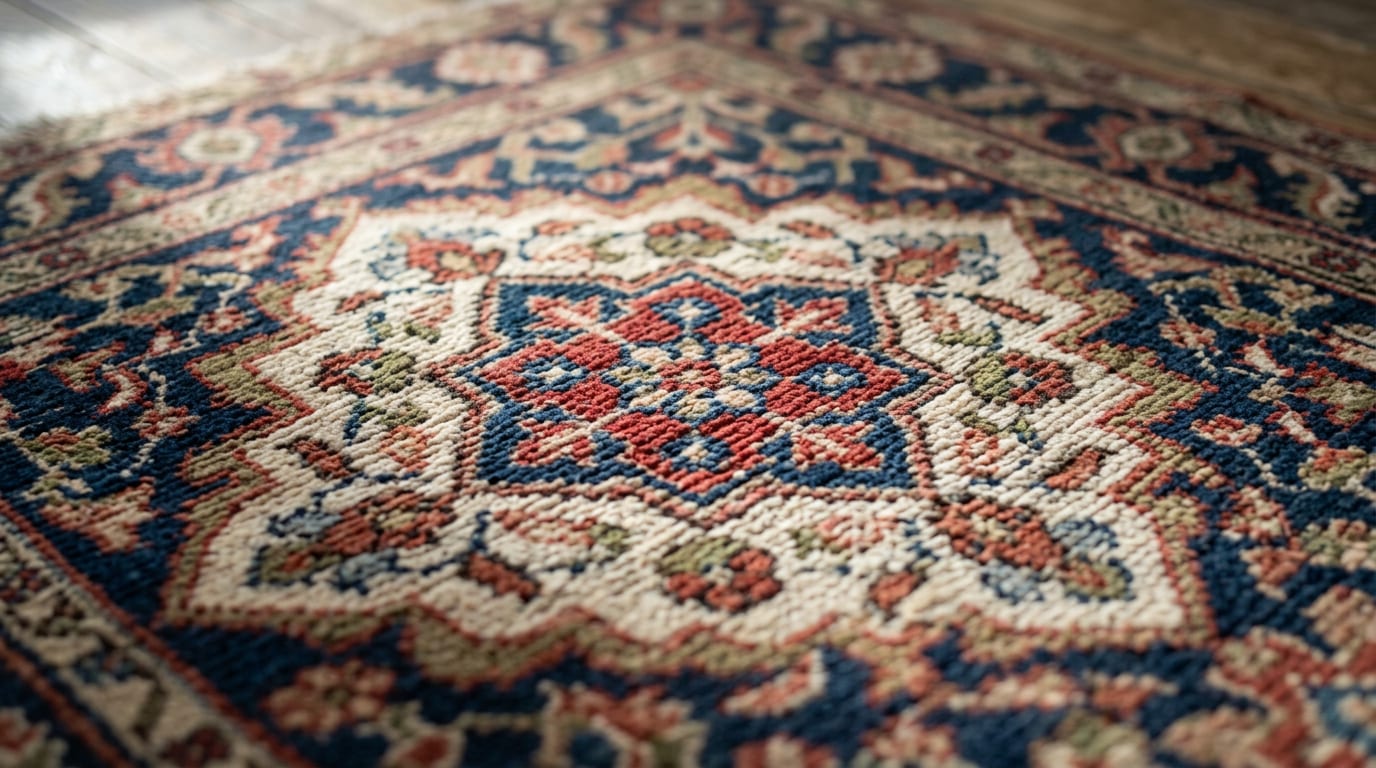
Wool is the most common fiber in high-value area rugs and hand-knotted pieces. It is also the most demanding to clean correctly. Wool is protein-based, which means it responds differently to chemistry than synthetic nylon or polyester. Alkaline cleaners — acceptable on synthetic fiber — can damage wool at high concentrations. Excess moisture can cause wool to shrink or felt. Aggressive hot-water extraction can distort the pile. The correct process for wool involves a controlled moisture level, pH-neutral or mildly acidic chemistry, and careful drying. A cleaner who learned on synthetic wall-to-wall and brings those habits to a wool rug is not well-matched to the task.
Silk-blend rugs are even more sensitive. Pure silk and high-percentage silk-blend rugs — common in formal rooms and collector holdings — require a dry or low-moisture method and specialized chemistry. Wet extraction is generally contraindicated. These rugs are often cleaned off-site at a specialist plant rather than in the home, and should only be handled by a cleaner with documented silk experience.
Synthetic fiber — nylon, polyester, polypropylene — is far more tolerant of standard hot-water extraction and carries less risk of chemistry-related damage. It still benefits from correct dwell time, appropriate soil-suspension chemistry, and thorough extraction to avoid residue, but the margin for error is larger than with natural fiber.
A working framework
Rather than a single interval, most of the homes Clean Freaks Co serves settle into a tiered rhythm. Primary living areas on a twice-yearly deep clean. High-traffic rooms and stair runners on a quarterly visit. Formal rooms that see little daily use on an annual pass, with an additional clean scheduled before a major hosting event. Homes with pets or young children often move the whole-home cadence to quarterly.
The point of the framework is not the numbers. It is that the cadence is set after a partner has seen the home — the fiber inventory, the traffic, the light — rather than quoted blind from a call center.
Method selection: hot-water extraction vs. low-moisture
The right cleaning method depends on fiber, construction, and condition — not on what the operator’s equipment happens to be. Hot-water extraction (sometimes called steam cleaning, though the water is hot rather than steam) is the most effective method for synthetic broadloom and most wool broadloom: it flushes the full depth of the fiber and removes the soil suspension rather than leaving it to wick back up as the carpet dries. It is not appropriate for rugs that cannot tolerate the moisture level or for certain natural-fiber constructions.
Low-moisture methods — encapsulation, dry compound, or controlled-moisture spraying with minimal extraction — are appropriate for situations where drying time is constrained, for fiber types that do not tolerate saturation, or for maintenance cleaning between deeper extractions. They are not equivalent to hot-water extraction for removing embedded soil; they are a different tool for a different purpose. A capable operator chooses between them based on the surface, not on equipment availability.
The cost of waiting too long
Soil is abrasive. Left in the fiber, it does not simply look worse — it acts like fine sandpaper at the base of the pile every time someone walks across it, and that wear does not reverse. The interval that protects a high-value carpet is shorter than the interval that merely keeps it looking acceptable. For a rug worth more than a vehicle, the maintenance math favors the shorter interval comfortably.
There is a secondary cost in fiber compression. Traffic lanes flatten pile over time through mechanical action. Regular professional cleaning, which includes pile-lifting and grooming as part of the process, slows this progression. A rug maintained on a correct cadence retains its hand and pile height longer than one cleaned only when it looks visibly dirty — which, for a high-quality wool pile, may be long after the structural damage from soil abrasion has begun.
If you would like a cadence proposed for your specific home, a Clean Freaks Co partner can assess it on a first visit. See carpet-cleaning coverage or request a quote.
Why trust this
Guidance held to a published standard.
Clean Freaks Co connects homeowners with carpet cleaning across Arizona, California, and Florida through approved, insured local partners who are verified for the fiber types present in the home before they are assigned to it. A partner who cannot demonstrate wool and natural-fiber competence does not receive referrals for homes with those materials.
This Journal is written and reviewed to that same standard — material guidance follows fiber manufacturer recommendations and IICRC-aligned trade sources and defaults to the conservative method when fiber sensitivity is a factor. Read how the Journal is written and reviewed.
Questions
Frequently asked.
Is hot-water extraction safe for wool rugs, or should I insist on a different method?
Hot-water extraction is appropriate for many wool rugs, but the parameters matter considerably. The water temperature, moisture volume, chemistry pH, and extraction thoroughness must all be calibrated for wool rather than applied at synthetic-fiber settings. Wool cleaned at excessive temperature or left with significant residual moisture can shrink, felt, or develop odor during the drying phase. A cleaner experienced in wool will adjust every parameter and ensure the rug dries quickly and completely. If you are uncertain about the operator’s wool experience, ask directly before the clean begins.
How do I know if a stair runner needs cleaning more often than the rest of the home?
Stair runners receive among the highest traffic loads of any textile in a home — every person ascending or descending concentrates foot traffic in a narrow band. If you can see a visible traffic lane on the runner — a slightly matted or differently colored path down the center of each tread — the runner is already overdue relative to the rest of the home. For most primary-use staircases in active households, a quarterly professional clean rather than annual keeps the fiber from accumulating the abrasive soil load that compresses pile permanently.
My housekeeper vacuums regularly. Does professional cleaning still matter at the same frequency?
Yes. Regular vacuuming is essential maintenance and extends the interval between professional cleans, but it does not substitute for them. A residential vacuum removes dry surface soil from the top of the fiber. It does not reach the base of the pile where fine grit and bound soil accumulate, does not remove oils and residues that attract soil and resist vacuum suction, and cannot lift compressed pile. Professional hot-water extraction or low-moisture cleaning reaches the full depth of the fiber and removes the material that vacuuming cannot. Both are necessary; they are not interchangeable.
Should high-value rugs be cleaned in the home or sent to a specialist facility?
For most wool area rugs, in-home cleaning by a qualified operator is appropriate and preferable, as it avoids the handling and transport exposure of sending the rug out. For very high-value hand-knotted pieces, antique rugs, or silk and high-percentage silk-blend rugs, an off-site specialist plant is often the better choice: the controlled environment, specialized equipment, and dedicated expertise at a rug-washing facility typically exceed what is achievable in a residential setting. The deciding factors are fiber type, age, condition, and value. Your cleaner should be transparent about which approach fits the piece.
How long should I expect a freshly cleaned carpet or rug to take to dry, and what affects that?
Drying time after hot-water extraction typically ranges from two to eight hours for carpet and rugs under normal conditions. The main variables are the moisture volume left after extraction (which skilled operators minimize), ambient humidity, air movement, and the thickness of the fiber. Desert climates with low humidity and good ventilation dry quickly. Coastal or humid environments take longer. Running ceiling fans and opening windows or running HVAC during the drying period reduces the window considerably. A rug that is still damp after twelve hours may have received excessive moisture during cleaning or may be in a poorly ventilated area — both worth noting for future visits.
Related reading
More from the Journal.


For your home
Carpet care, matched to your home.
When the carpet in your home needs more than routine attention, we connect you with an approved local partner who knows the fiber, the traffic, and the standard your home keeps. See carpet cleaning coverage, or send the details and your local partner will be in touch.
Request a quote
About Clean Freaks Co
Clean Freaks Co is a premier luxury home cleaning service company that has carved a niche in the cleaning industry with its top-tier services. With a keen focus on luxury homes, we ensure every detail is handled with the utmost care and precision, providing a level of service that goes above and beyond the norm.
Our services are comprehensive and tailored to meet the unique needs of luxury homes. We offer residential cleaning, carpet & floor cleaning, window cleaning, and exterior cleaning. Our team of professionals is committed to providing the highest level of service, ensuring your home is pristine and inviting.
We believe in using natural cleaning products that not only deliver exceptional results but also protect our clients and the environment. Our commitment to eco-friendly cleaning solutions is part of our mission to provide a clean and safe environment for luxury homeowners.
Clean Freaks Co operates in three major states, specifically in Atherton & Los Altos Hills, California; Paradise Valley, Arizona; and Jupiter Island & Golden Beach, Florida. We are proud to serve luxury homeowners in these areas and are dedicated to exceeding our clients' expectations with every service we provide.
Choosing Clean Freaks Co means choosing a team that understands the unique needs of luxury homes. Our attention to detail, commitment to using natural cleaning products, and dedication to providing a superior customer experience set us apart. We take pride in transforming luxury homes into pristine living spaces where our clients can relax and enjoy their surroundings.
For more information or to schedule a service, please contact us at skyler.salterra@gmail.com. We look forward to providing you with a clean and safe environment that you'll love.
Written and published by Clean Freaks Co. How the Journal is written and reviewed →