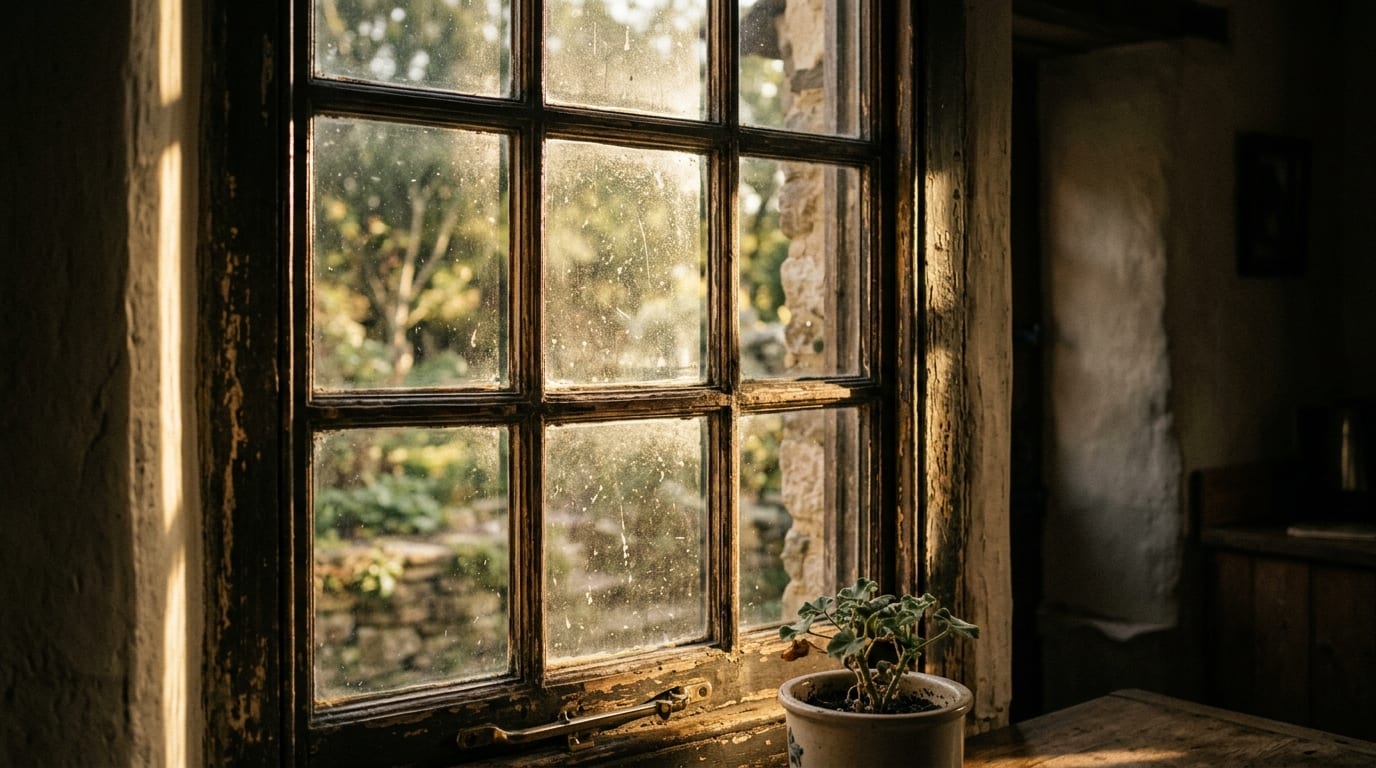
Cloudy and Etched Glass: What Restores and What Is Permanent
A window that stays cloudy after cleaning is sending a signal. Sometimes it means the glass needs restoration. Sometimes it means the glass is permanently damaged. Telling the two apart matters before anyone spends money on it.
Three different kinds of “cloudy”
“Cloudy glass” is not one condition. It is at least three, with very different outcomes:
- Surface film — restorable. Bonded hard-water mineral or coastal salt sits on top of the glass. It resists ordinary cleaner but yields to the correct restoration chemistry. The glass underneath is sound. This is the good case, and the most common.
- Surface etching — usually permanent. If mineral deposits are left on glass long enough, or removed with abrasive force, they can etch the surface itself — a microscopic roughening that scatters light. Etching is in the glass, not on it. No cleaning removes it.
- Failed insulated-glass seal — not a cleaning issue at all. A double-pane unit with a broken seal collects condensation between the panes. It looks like cloudy glass and is sometimes mistaken for one. It cannot be cleaned — the cloud is on an interior surface no cleaner can reach. It is a glass-replacement matter.
How surface film actually bonds
Understanding why film bonds helps predict where it will appear first. Hard water contains dissolved calcium and magnesium carbonates. When water contacts glass and then evaporates — from a sprinkler overspray, from rain, from condensation — those minerals remain behind as a thin residue. Each subsequent wetting-and-drying cycle deposits another layer on top of the last. Given enough cycles, the deposit cross-links with the glass surface at a chemical level and ceases to be simply “on top.” That threshold — deposit to bond — happens faster in direct sun, which accelerates evaporation, and in regions with higher mineral load in the municipal supply. West-facing windows that take afternoon heat are typically the first to show the problem on a desert property. Coastal glass accumulates chloride film on a different chemistry, but the same layering mechanism applies.
The practical implication is that film caught within its first few cycles is far easier to lift than film that has been building for a season or more. Restoration chemistry on early-stage film often requires a single application and careful mechanical agitation. Late-stage film may require multiple passes, extended dwell time, and a finer abrasive compound before the glass runs clear.
How a professional tells them apart
A capable window partner diagnoses before quoting. Bonded film can be felt and tested — a small restoration test on an inconspicuous area shows whether the cloud lifts. Etching does not respond to that test. A failed seal reveals itself because the cloud is unreachable from either face and often shifts with temperature. The honest partner runs this assessment and tells you which of the three you have — including when the answer is “this glass cannot be saved by cleaning.”
The test patch protocol matters because it removes guesswork from the quote. A partner who commits to a full restoration without testing first is either confident the glass is restorable (which is a reasonable position on young, lightly soiled glass) or is avoiding the conversation about permanent damage. On glass that has been neglected for multiple seasons, the test patch is not a formality — it is the only honest way to know what you are actually buying.
The failure mode of etching
Etching deserves a more precise description than “in the glass, not on it.” The mechanism is a slow dissolution of the soda-lime silica matrix at the glass surface by carbonic acid formed when carbon dioxide in rainwater combines with water. Acidic cleaners applied to glass without adequate rinsing can accelerate the same process. Abrasive pads used without the correct lubricating compound compound the problem mechanically. The result in each case is a surface that, under magnification, looks frosted — thousands of micro-pits and micro-scratches that individually are invisible but collectively scatter enough light to produce the cloudy appearance. Polishing compounds can reduce mild etching by resurfacing the outermost layer, but significant etching means the glass has lost surface material that cannot be restored without specialized optical polishing — a service available for some architectural glass but rarely economical on standard residential glazing.
Why the diagnosis protects you
The diagnosis protects you from two mistakes: paying for repeated restoration attempts on glass that is etched and will never clear, and paying for cleaning on a window whose real problem is a failed seal that needs the unit replaced. It also points to prevention — surface film caught and removed on a regular cadence never gets the chance to become etching.
For a failed insulated-glass unit, the diagnosis redirects the conversation to glazing replacement, which is a different trade and a different cost category than cleaning. An honest window professional identifies the condition and refers appropriately rather than accepting payment for a cleaning service that will not change the appearance of the glass.
The prevention takeaway
Etching is, in most cases, neglected film that was left too long or removed too harshly. The maintenance cadence that keeps film from bonding is the same thing that keeps glass from ever reaching the permanent stage. In a hard-water region — which includes most of Arizona and significant parts of inland California — twice-yearly professional cleaning is a reasonable baseline for windows with regular sprinkler exposure. Coastal properties, where chloride accumulation runs faster, often benefit from quarterly attention on the ocean-facing elevation. The intervals are not arbitrary; they are calibrated to the rate at which film advances toward bond.
The cleaning method matters as much as the cadence. A professional using the correct restoration chemistry with appropriate mechanical agitation removes the deposit without scratching the glass. A consumer using a wire pad or an acidic household cleaner on glass that has not been tested for compatibility can turn a restorable film problem into an irreversible etching problem in a single afternoon.
Honest glass diagnosis — restorable, etched, or failed seal — is part of what our window partners provide. See window-cleaning coverage or request a quote.
Why trust this
Guidance held to a published standard.
Clean Freaks Co connects homeowners with professional window cleaning and restoration across Arizona, California, and Florida through approved, insured local partners held to a published standard. Every partner is assessed for the correct diagnostic practice before joining the network — including the ability to distinguish surface film, surface etching, and failed insulated-glass seals before a restoration quote is given.
This Journal is written and reviewed to that same standard — material guidance follows glass industry and manufacturer sources and defaults to the conservative method. Read how the Journal is written and reviewed.
Questions
Frequently asked.
Can hard-water film on glass be removed at home without a professional?
Light, recent film sometimes responds to a diluted white-vinegar solution or a citric-acid-based glass cleaner applied with a soft, non-abrasive pad. The risk is that consumer products and incorrect technique can streak the glass, introduce fine scratches, or fail entirely on bonded deposits. On glass with noticeable cloudiness that has been present for more than one season, professional restoration chemistry and proper mechanical agitation are the more reliable approach.
How can I tell whether my cloudy double-pane window has a failed seal rather than surface film?
The most reliable indicator is location: if the cloudiness appears between the two panes rather than on the interior or exterior face you can touch, the seal has failed. Condensation between panes often shifts or disappears temporarily on warm days as thermal pressure changes, then returns. A restoration test on the exterior face — which should clear surface film — will produce no change on a failed-seal unit.
Is etched glass always a write-off, or can anything be done?
Mild etching — the kind produced by a single episode of harsh cleaning or a short period of mineral neglect — can sometimes be reduced through optical polishing compounds that resurface the outermost layer of the glass. Significant or long-standing etching means the surface material loss is too deep for polishing to address without introducing optical distortion. A qualified professional can assess the degree and give an honest opinion on whether polishing is likely to produce a visible improvement.
How often should windows be professionally cleaned to prevent film from bonding?
The interval depends on exposure. Windows subject to regular sprinkler overspray in a hard-water region can show bonding deposits within six to eight weeks in full sun. As a baseline, twice-yearly professional cleaning covers most inland residential windows. Ocean-facing glass on a coastal property often benefits from quarterly service. The right partner will assess your specific exposure and recommend an interval calibrated to it rather than offering a one-size schedule.
What happens if a restoration technician attempts to clean glass that turns out to be etched?
Restoration chemistry and mechanical agitation on etched glass will not worsen the etching — the damage is already in the surface. The glass simply will not clear. An honest partner recognizes the non-response during the test-patch phase, stops, and explains the finding rather than continuing to charge for a service that will not produce a result. The correct next conversation is whether optical polishing is warranted or whether the glass has reached end of life.
Related reading
More from the Journal.



For your home
Window care, held to a standard.
When your glass needs a cleaner who works to a verified standard, we connect you with an approved local partner who knows your home before the first visit. See window cleaning coverage, or send the details and your local partner will be in touch.
Request a quote
About Clean Freaks Co
Clean Freaks Co is a premier luxury home cleaning service company that has carved a niche in the cleaning industry with its top-tier services. With a keen focus on luxury homes, we ensure every detail is handled with the utmost care and precision, providing a level of service that goes above and beyond the norm.
Our services are comprehensive and tailored to meet the unique needs of luxury homes. We offer residential cleaning, carpet & floor cleaning, window cleaning, and exterior cleaning. Our team of professionals is committed to providing the highest level of service, ensuring your home is pristine and inviting.
We believe in using natural cleaning products that not only deliver exceptional results but also protect our clients and the environment. Our commitment to eco-friendly cleaning solutions is part of our mission to provide a clean and safe environment for luxury homeowners.
Clean Freaks Co operates in three major states, specifically in Atherton & Los Altos Hills, California; Paradise Valley, Arizona; and Jupiter Island & Golden Beach, Florida. We are proud to serve luxury homeowners in these areas and are dedicated to exceeding our clients' expectations with every service we provide.
Choosing Clean Freaks Co means choosing a team that understands the unique needs of luxury homes. Our attention to detail, commitment to using natural cleaning products, and dedication to providing a superior customer experience set us apart. We take pride in transforming luxury homes into pristine living spaces where our clients can relax and enjoy their surroundings.
For more information or to schedule a service, please contact us at skyler.salterra@gmail.com. We look forward to providing you with a clean and safe environment that you'll love.
Written and published by Clean Freaks Co. How the Journal is written and reviewed →